
Lower Middle Market 2H Outlook: Valuations, Deal Activity & Market Trends (Part 1)
Part 1 of Axial’s 2H 2026 M&A Outlook Series Axial members entered 2026 with cautious optimism about a more stable…


Part 3 of Axial’s 2H 2026 M&A Outlook Series
Part 1 of Axial’s 2H 2026 M&A Outlook Series presented findings from surveyed Axial dealmakers on deal activity, valuations, buyer competition, and uncertainty, comparing their mid-year outlook with expectations from the start of the year.
Part 2 featured responses from buyers and investors on acquisition targets, closing conditions, capital deployment, and pricing discipline.
Today, Part 3 turns to the sell-side, featuring insights from Axial M&A advisors and comparisons with the start-of-year survey where applicable.
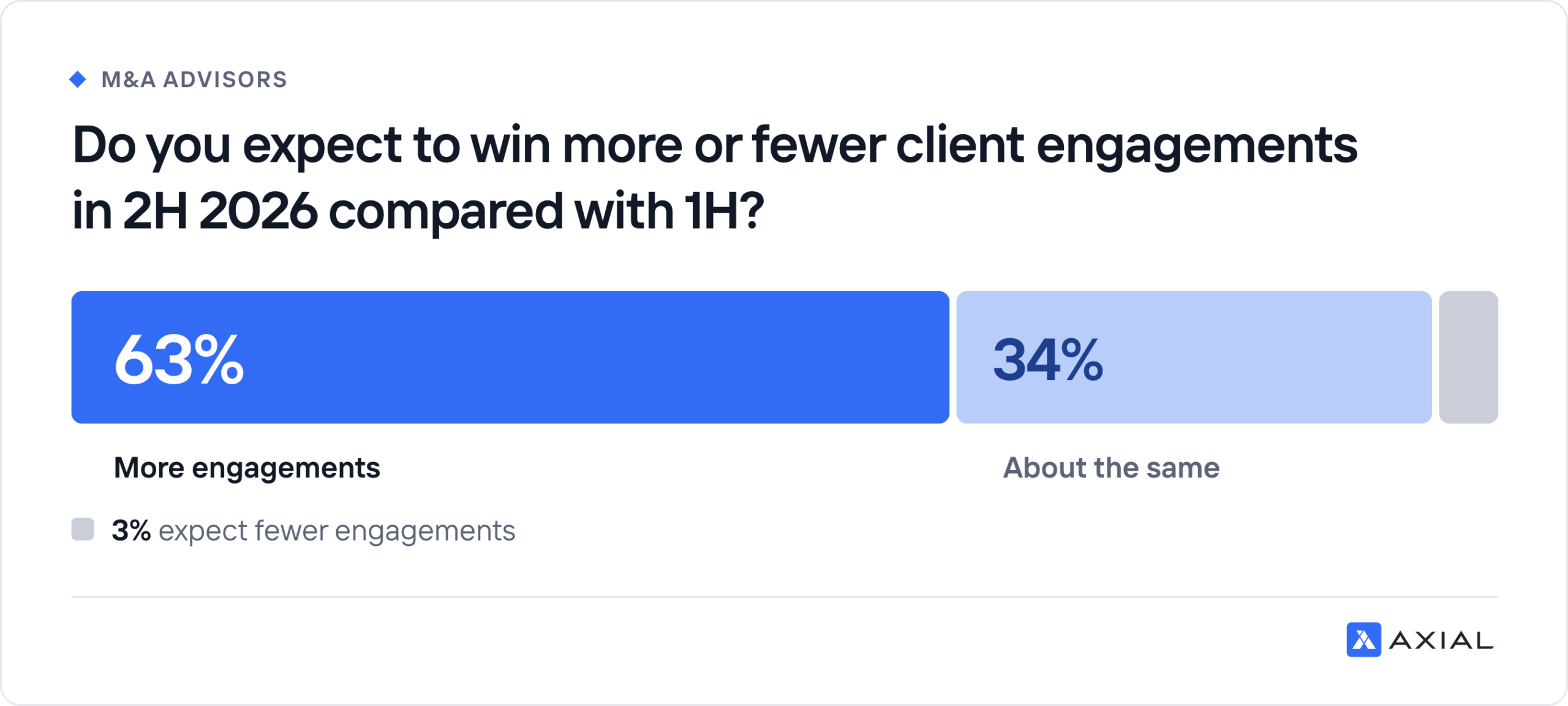
Advisors are optimistic about new business in the second half of the year, with 63% expecting to win more client engagements than in 1H. Just 3% anticipate fewer engagements, while the remaining 34% expect activity to hold steady.
For a closer look at how advisors are structuring those engagements, Axial’s 2026 M&A Fee Guide benchmarks engagement fees, success fee structures, and other common terms across the lower middle market.
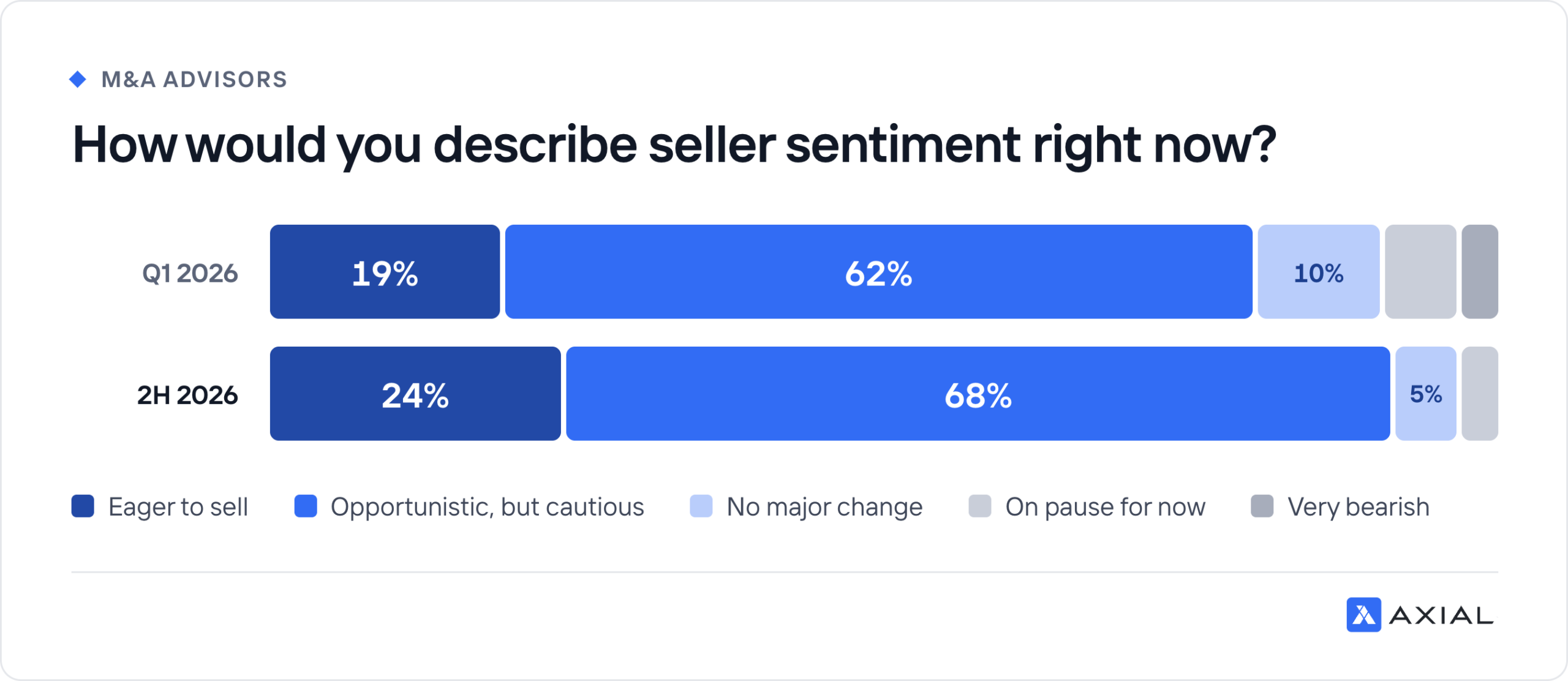
Most advisors continue to describe business owners as opportunistic but cautious, with that share rising from 62% at the start of the year to 68% at mid-year. The share describing owners as eager to sell also increased, from 19% to 24%, while the share reporting that owners are on pause declined.
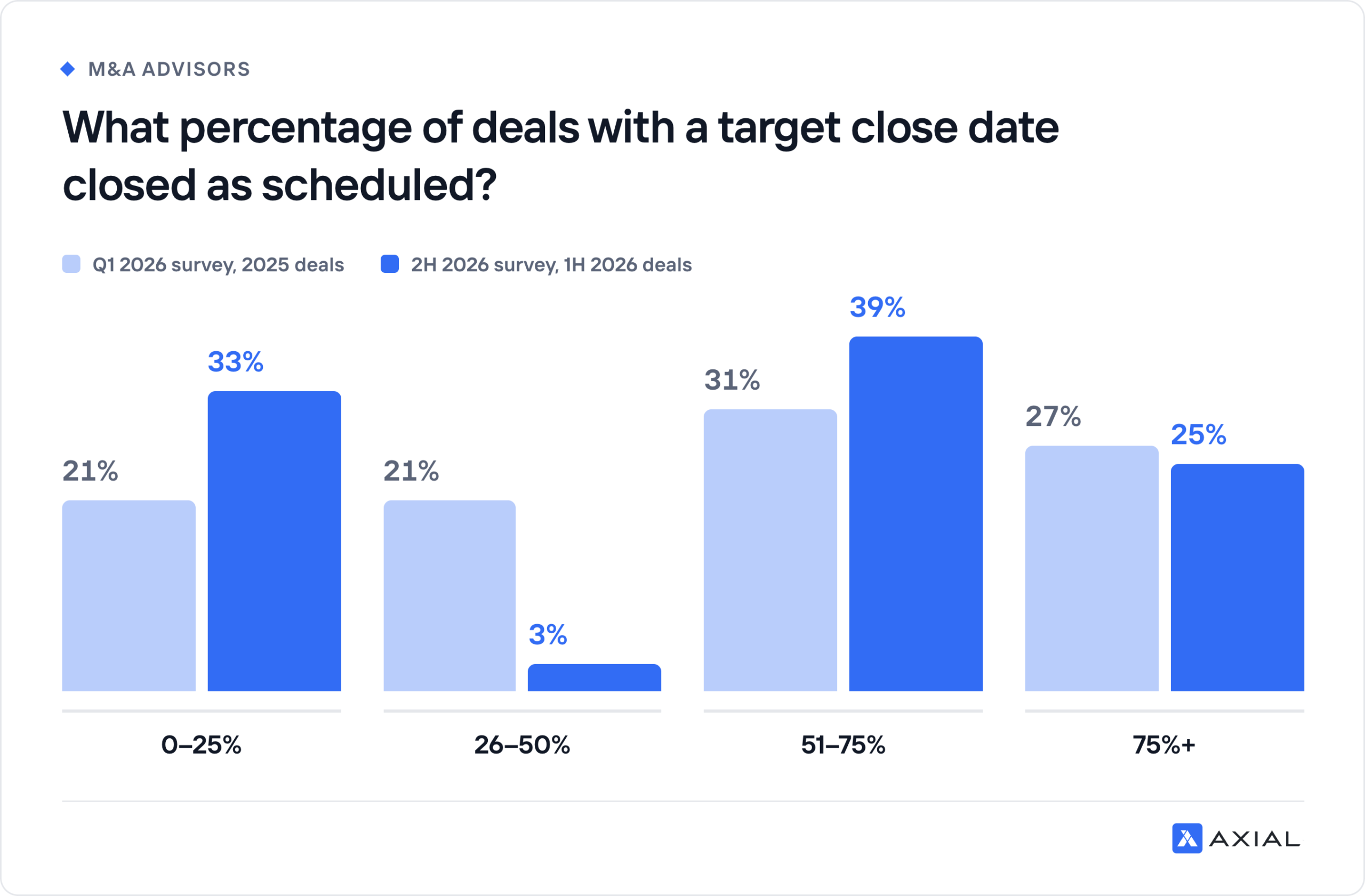
In 1H 2026, 64% of advisors said a majority of deals with target close dates closed as scheduled, compared with 58% for 2025 deals. At the same time, the share reporting that one-quarter or fewer closed as scheduled increased from 21% to 33%, while the 26% to 50% range fell from 21% to just 3%.
Among deals that did not close as intended, 51% of advisors said more are going on hold, while only 10% reported that more are dying. The results are nearly unchanged from the previous survey, suggesting that delays remain more common than permanent breakdowns.
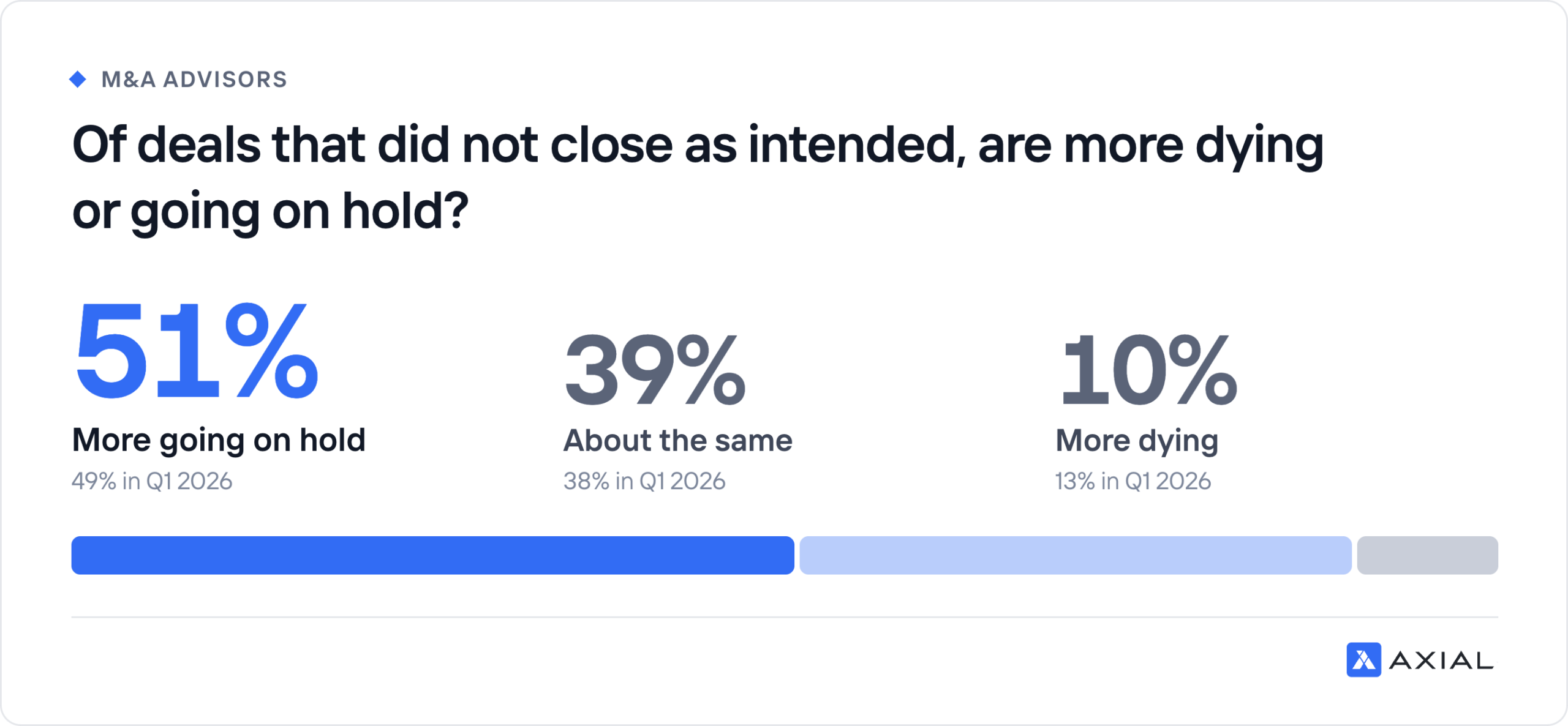
Advisors pointed to valuation gaps and weaker business performance, deeper diligence and financing challenges, and owner hesitation or shifting buyer priorities as common causes. As Lane Carrick discusses in a recent episode of Masters in Small Business M&A, emotion, buyer chemistry, and second-guessing can also put otherwise viable transactions at risk near the finish line.
The table below features a selection of respondents’ explanations for why deals are going on hold or failing to close.
| Member + Firm | Dying or on hold? | Cause(s) |
|---|---|---|
| Kyle Bobinski, Structures Partners | More are going on hold | Market effect. Consumers are becoming tighter with their money, opting to delay and/or scrutinize discretionary purchases for as long as they can. This results in reduced sales compared to last year and when measuring the LTM (TTM) period, so QoE passes, but business comps are down relative to prior calendar year/months and a 'retrade' begins. |
| Vipin Singh, Murphy Business Sales | About the same | Deals typically succumb to a slow erosion of trust, deal fatigue, or a mismatch between early expectations and the realities of diligence. |
| Barton Webb, Janas Associates | More are going on hold | Sales and earnings challenges. |
| Jack Farris, Farris Capital Partners, LLC | About the same | Quality companies in AI-defensible industries, with sustained growth, are in big demand and closing on time. Very niche companies, or those with any blemishes, are taking longer to find the perfect buyer. |
| Lane Carrick, Optima Mergers & Acquisitions | More are dying | Sellers are choosing not to transact for various reasons, but mostly valuation issues. |
| Leonardo Ferreira, Hill View Partners | More are going on hold | The main causes are valuation gaps and shifting buyer priorities. |
| Kaloyan Popov, Nextoria | About the same | First-time entrepreneurs tend to be cautious, often overthinking decisions and becoming emotionally overinvested. |
| Darren Day, Gar Wood Securities | More are dying | Lack of interest from investors. |
| Bill Schloth Jr., ASA Ventures Group. | More are going on hold | We had a few deals go on hold because regulatory changes negatively impacted our client's company. |
| Jay Jung, Embarc Advisors | About the same | Deeper diligence; unsuccessful financing. |
The percentage of advisors reporting a growing gap between owner expectations and buyer willingness to pay increased from 24% in Axial’s 2026 full-year outlook to 41% at mid-year. Just 18% now see the gap shrinking, meaning 82% believe the disconnect has stayed the same or grown.
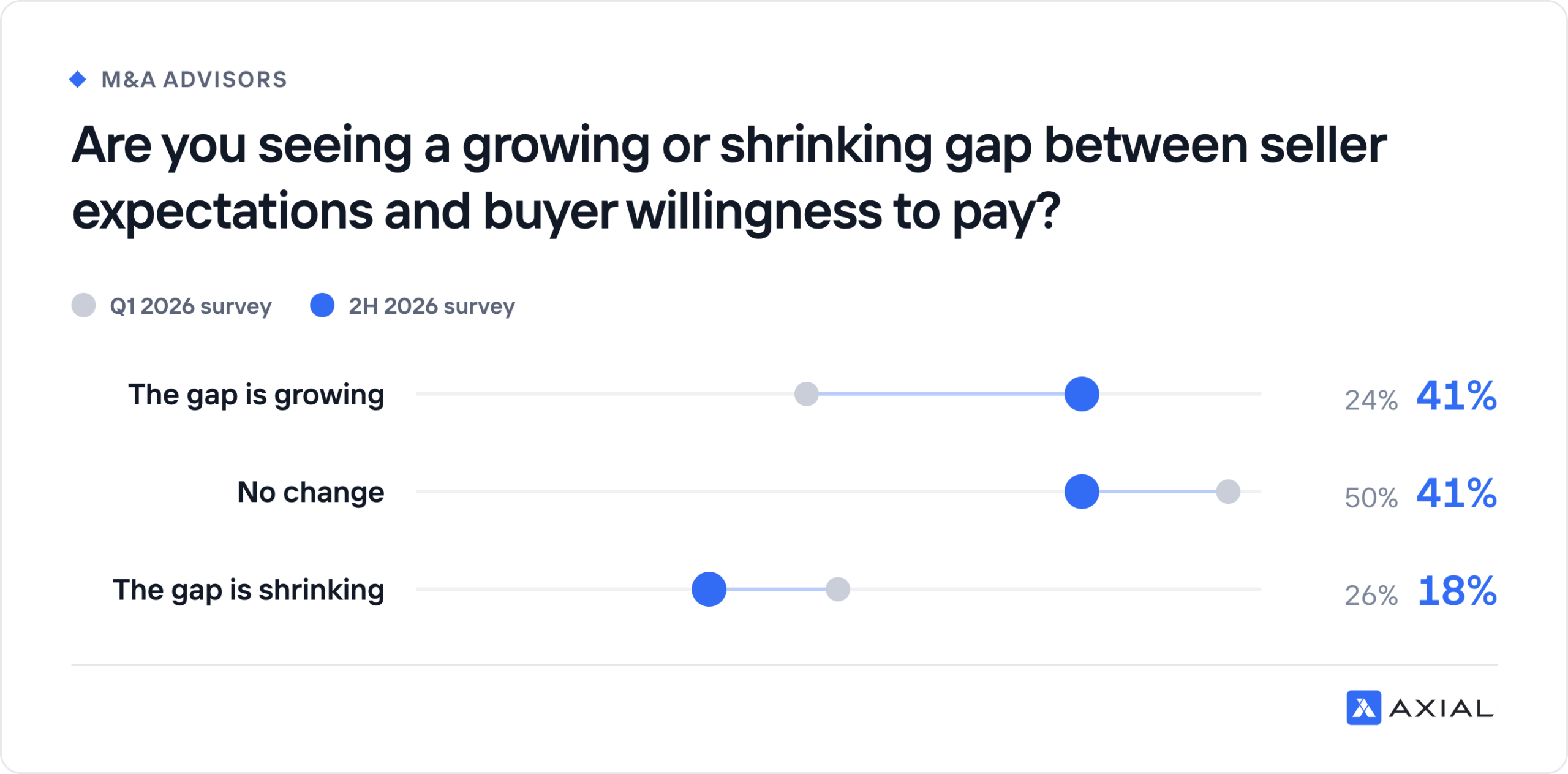
That disconnect may be reinforced by the growing use of AI in valuation discussions. In an article on AI’s role in valuation negotiations, M&A advisor Max Friar explains how buyers and owners can use the technology to support opposing price expectations without adding new market evidence. For advisors, this makes it even more important to ground pricing conversations in buyer feedback, lender appetite, deal structure, diligence findings, and certainty of closing.
For owners considering a sale, Axial’s Business Valuation Calculator offers a practical starting point. It uses a simplified version of the discounted cash flow (DCF) methodology commonly used by buyers and M&A advisors to estimate a company’s value.
M&A advisors enter the back half of 2026 with a healthy engagement outlook and signs of growing owner interest to sell. However, variation in scheduled closing outcomes and the prevalence of delayed processes show that activity alone will not necessarily translate into completed transactions.
With the buyer-owner valuation gap widening, successful processes will likely depend on setting realistic expectations early, preparing for deeper diligence, and addressing performance and financing concerns before they disrupt negotiations. Advisors who establish alignment and maintain trust throughout the process may be best positioned to keep viable deals moving toward close.
Axial surveyed 79 lower middle market dealmakers in July 2026, including 40 buyers and investors (51%) and 39 sell-side M&A advisors (49%). Of the respondents, 66% worked at firms with fewer than 10 employees, 24% at firms with 11 to 40 employees, and 10% at firms with more than 40 employees.
Where noted, results are compared with Axial’s 2026 M&A Outlook Report to show how market perspectives have evolved since the start of the year. Results reflect the views of participating Axial members and should be considered directional rather than representative of the entire lower middle market.