

Lower Middle Market 2H Outlook: Valuations, Deal Activity & Market Trends (Part 1)
Part 1 of Axial’s 2H 2026 M&A Outlook Series Axial members entered 2026 with cautious optimism about a more stable…


Part 2 of Axial’s 2H 2026 M&A Outlook Series
Last week, we released Part 1 of Axial’s 2H 2026 M&A Outlook Series, which presented the broader lower middle market outlook based on survey responses from 79 Axial members and tracked how dealmaker perspectives have changed since our start-of-year survey report.
Part 2 focuses on responses from 40 buyers and investors, highlighting continued acquisition momentum despite a tougher closing environment.
Key takeaways:
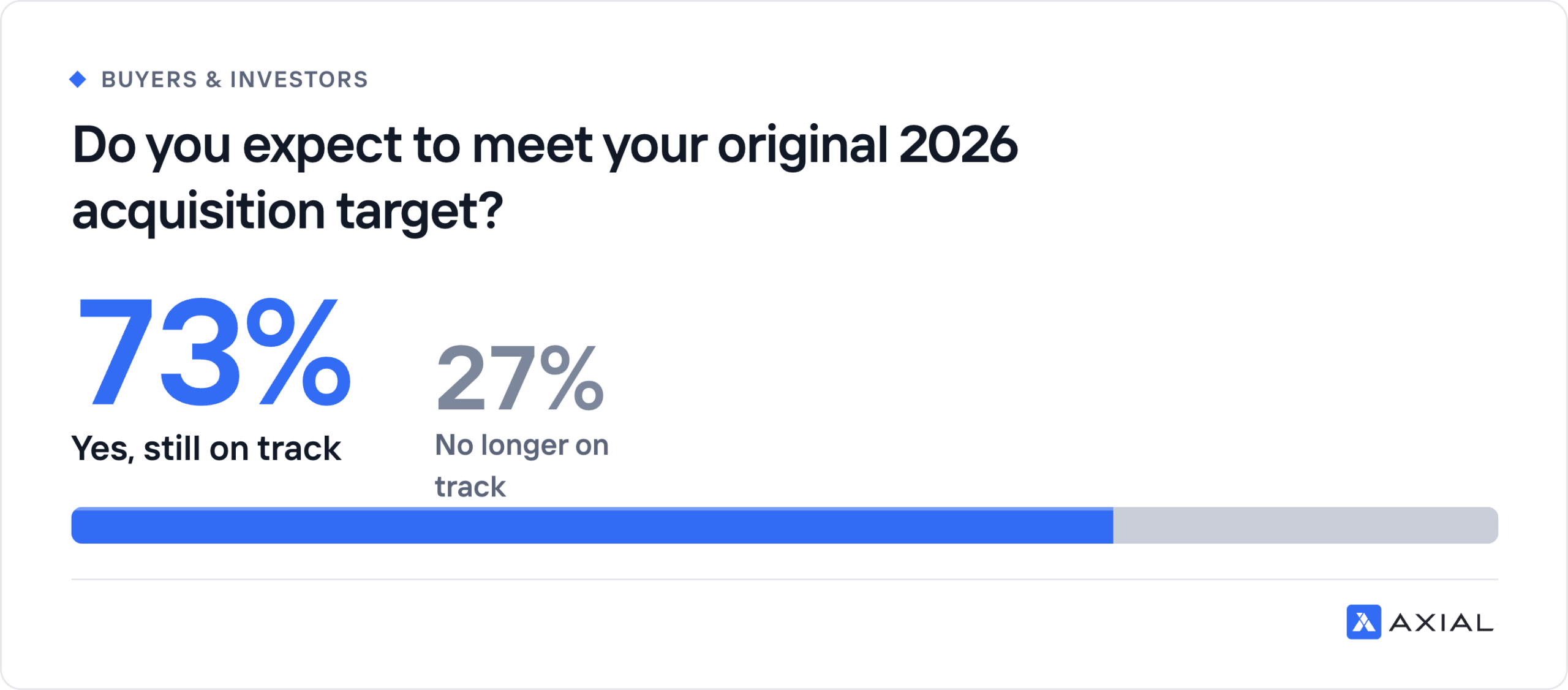
At midyear, nearly three-quarters (73%) of surveyed buyers and investors still expect to meet the acquisition targets they set at the beginning of 2026.
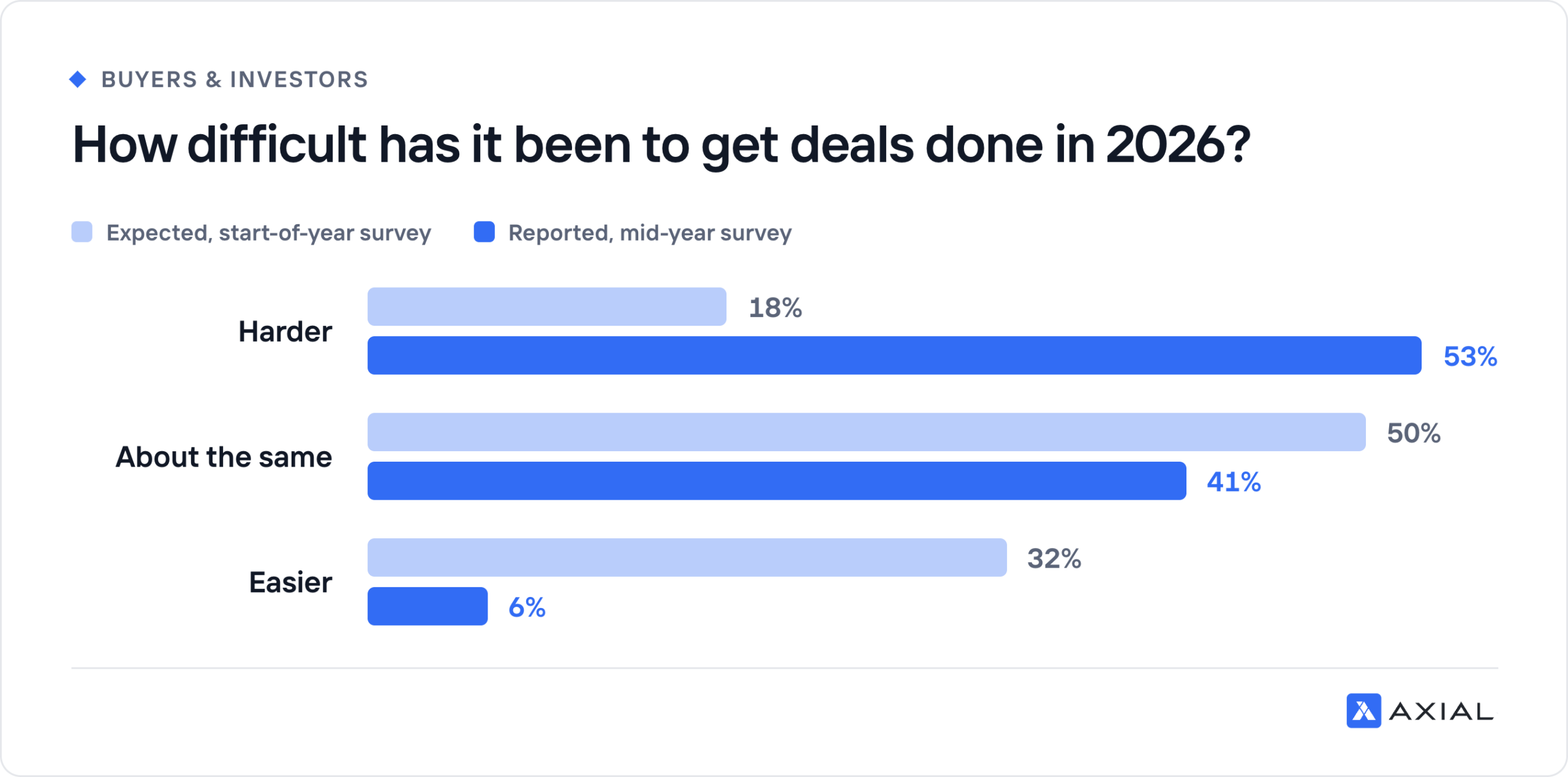
At the start of 2026, just 18% of buyers expected a more challenging deal environment compared to 2025. By mid-year, 53% of surveyed buyside members reported that getting deals done had been harder, nearly 3x the percentage recorded in the Q1 survey. A meaningful 41% said conditions remained about the same, while only 6% found them easier, compared with the 32% who had expected improved conditions.
To better understand the factors affecting deal execution, we asked buyers to elaborate on their responses. Recurring themes included high or unclear valuation expectations, increased competition and the challenge of finding the right fit, and uncertainty related to business performance, lending conditions, and AI. Several buyers also described processes as slower or more resource-intensive. See the table below for select insights.
| Member + Firm | Difficulty vs. previous years | Reasoning |
|---|---|---|
| Brad Kugler, DirectMail2.0 | Harder | Separating the wheat from the chaff is a big commitment in time and resources. |
| David Eshaghian, Panther Equity Group | About the same | Every year has different challenges (AI disruption, interest rates, geopolitics/tariffs, specific industry challenges, etc.). |
| Dennis Huang, Polychrome | Harder | I think valuations and expectations are very muddled right now. Anything AI-related is on fire, but anything software-related is looked at very poorly; but where do you draw the line between the two? There's a messy middle where a lot of businesses lie, and getting to an understanding on valuation is trickier than ever. |
| Kristen Bistany, Mangrove Equity Partners | Easier | We have found the lower middle market to be robust in terms of deal flow that fits within our core criteria. |
| Charles Scripps, Black Lake Capital | Harder | Uncertainty in the global economy has reduced selling business performance and made lenders less likely to invest. |
| Luke Phenicie, Kissel Capital | Harder | The lower middle market is very competitive right now. |
| Kamil Homsi, GRC Investment Group | About the same | The global macro remain the same, inflation, cost of living and more. |
| Enzo Loe, Inou Holdings LLC | About the same | Same as before but I have more deal flow and a better network of capital providers. |
| Mike Alberts, Cohere Capital | Harder | Everything is just taking a little longer… sell-side processes, negotiation, diligence, capital markets, etc. |
| Jonathan Haski, Floor Plan Inc. | About the same | Getting these deals done is less about valuation than about finding an owner who wants the kind of partnership we offer. We would rather hold our goal and stay selective than force a transaction. When the right opportunity appears, we are capitalized and ready to move quickly. |
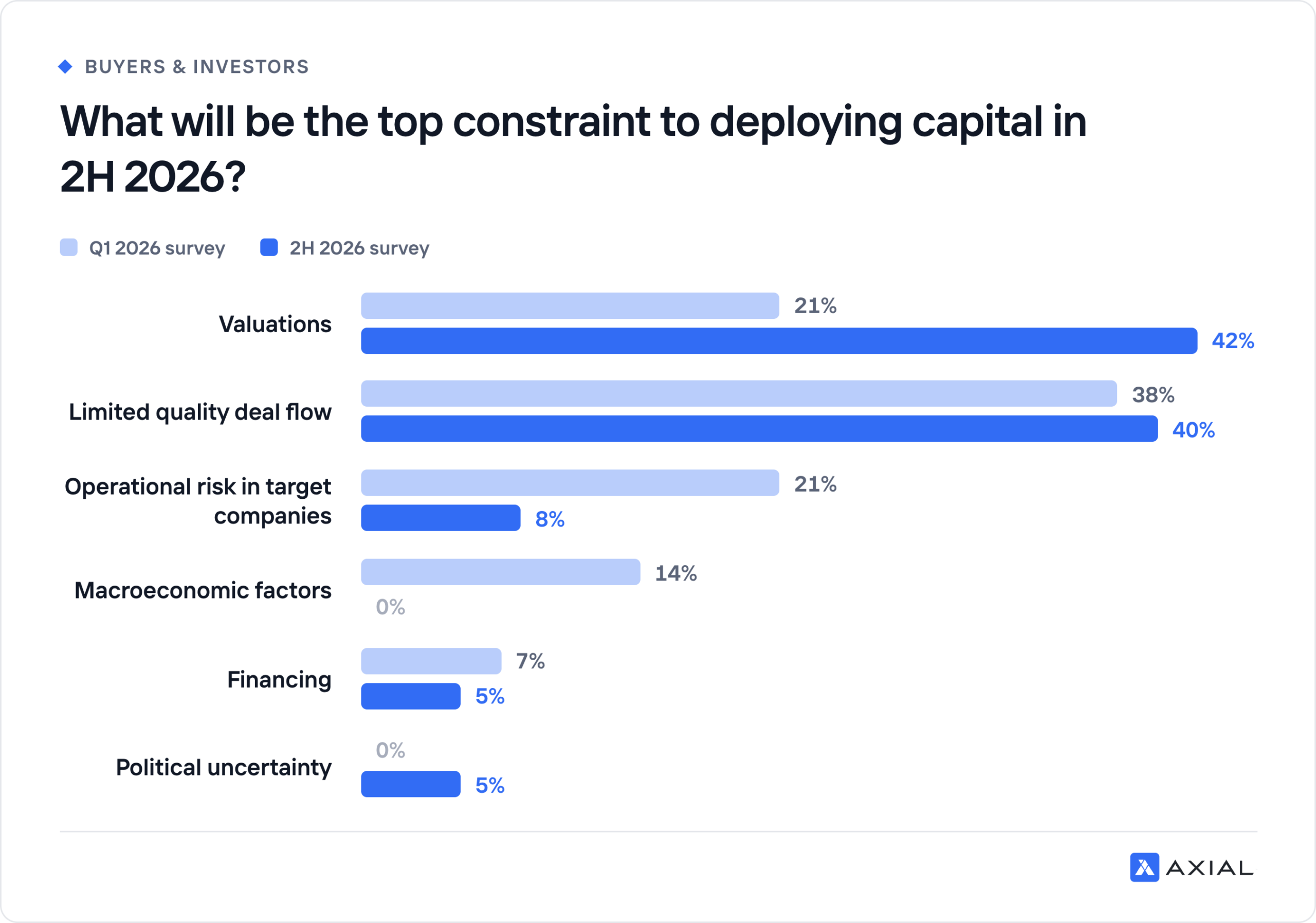
Valuations emerged as the leading constraint to deploying capital in 2H 2026, cited by 42% of buyers, double the 21% recorded in the Q1 survey. Limited quality deal flow remained close behind at 40%. Together, these two factors accounted for 82% of responses, while concerns about operational risk, macroeconomic conditions, and financing declined.
Combined, 45% of buyers are very or somewhat willing to stretch on valuation for a high-quality asset, largely unchanged from 48% in the Q1 survey. However, neutral responses nearly tripled from 11% to 32%, while the percentage of buyers who are somewhat reluctant or not willing at all fell from 41% to 23%.
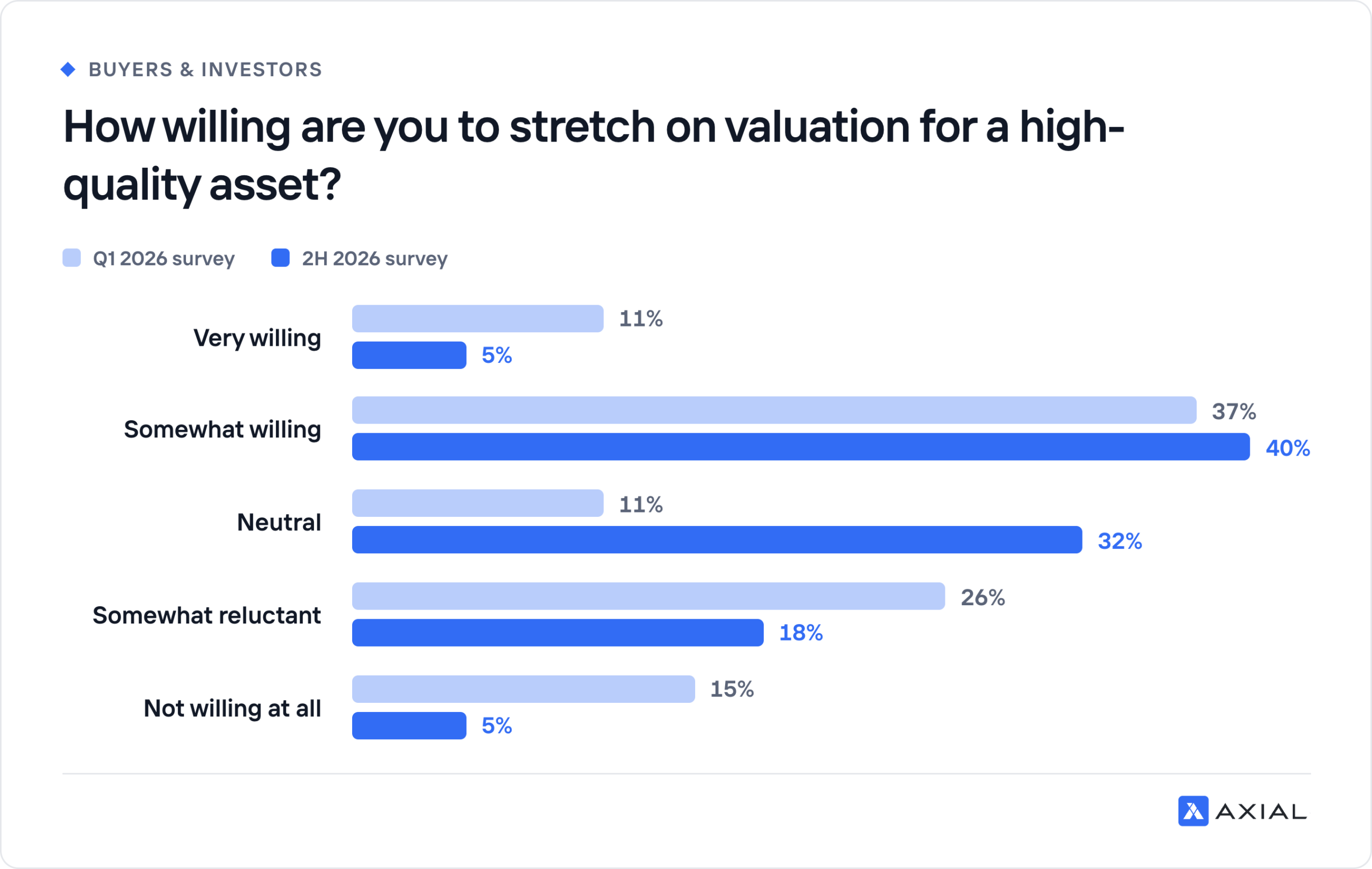
Buyers remain committed to their acquisition goals, but the path to closing has become more challenging. Valuations have overtaken deal flow as the leading constraint, while the increase in neutral responses on stretching suggests that buyers are evaluating opportunities more selectively rather than broadly retreating from the market.
Buyers that establish valuation alignment early, maintain discipline, and remain prepared to move quickly on the right opportunities will likely be best positioned to convert active pipelines into completed acquisitions.
Subscribe below to Axial’s Middle Market Review to receive the next installments in the 2H 2026 M&A Outlook Series, including survey findings from M&A advisors, takeaways for business owners, and a look at how dealmaker sentiment compares with activity on the Axial platform.
Axial surveyed 79 lower middle market dealmakers in July 2026, including 40 buyers and investors (51%) and 39 sell-side M&A advisors (49%). Of the respondents, 66% worked at firms with fewer than 10 employees, 24% at firms with 11 to 40 employees, and 10% at firms with more than 40 employees.
Where noted, results are compared with Axial’s 2026 M&A Outlook Report to show how market perspectives have evolved since the start of the year. Results reflect the views of participating Axial members and should be considered directional rather than representative of the entire lower middle market.