



Lower Middle Market 2H Outlook: M&A Advisors on Owner Sentiment, Deal Execution & Valuation Gaps (Part 3)
Part 3 of Axial’s 2H 2026 M&A Outlook Series Part 1 of Axial’s 2H 2026 M&A Outlook Series presented findings…
Part 1 of Axial’s 2H 2026 M&A Outlook Series
Axial members entered 2026 with cautious optimism about a more stable and productive M&A environment. At mid-year, the outlook remains constructive, but valuation misalignment, longer timelines, and financing pressure continue to complicate execution.
The series draws on insights from a recent Axial member survey of 79 lower middle market dealmakers from both the buyside and sell-side. Where applicable, it compares the findings with Axial’s 2026 M&A Outlook Report, highlighting how perspectives on deal activity, valuations, and broader market conditions have evolved since the start of the year.
Today’s report features perspectives from both Axial investors and M&A advisors on the forces shaping the back half of 2026.
Subsequent installments take a more in-depth look at each audience through responses to questions specific to the buyside and sell-side.
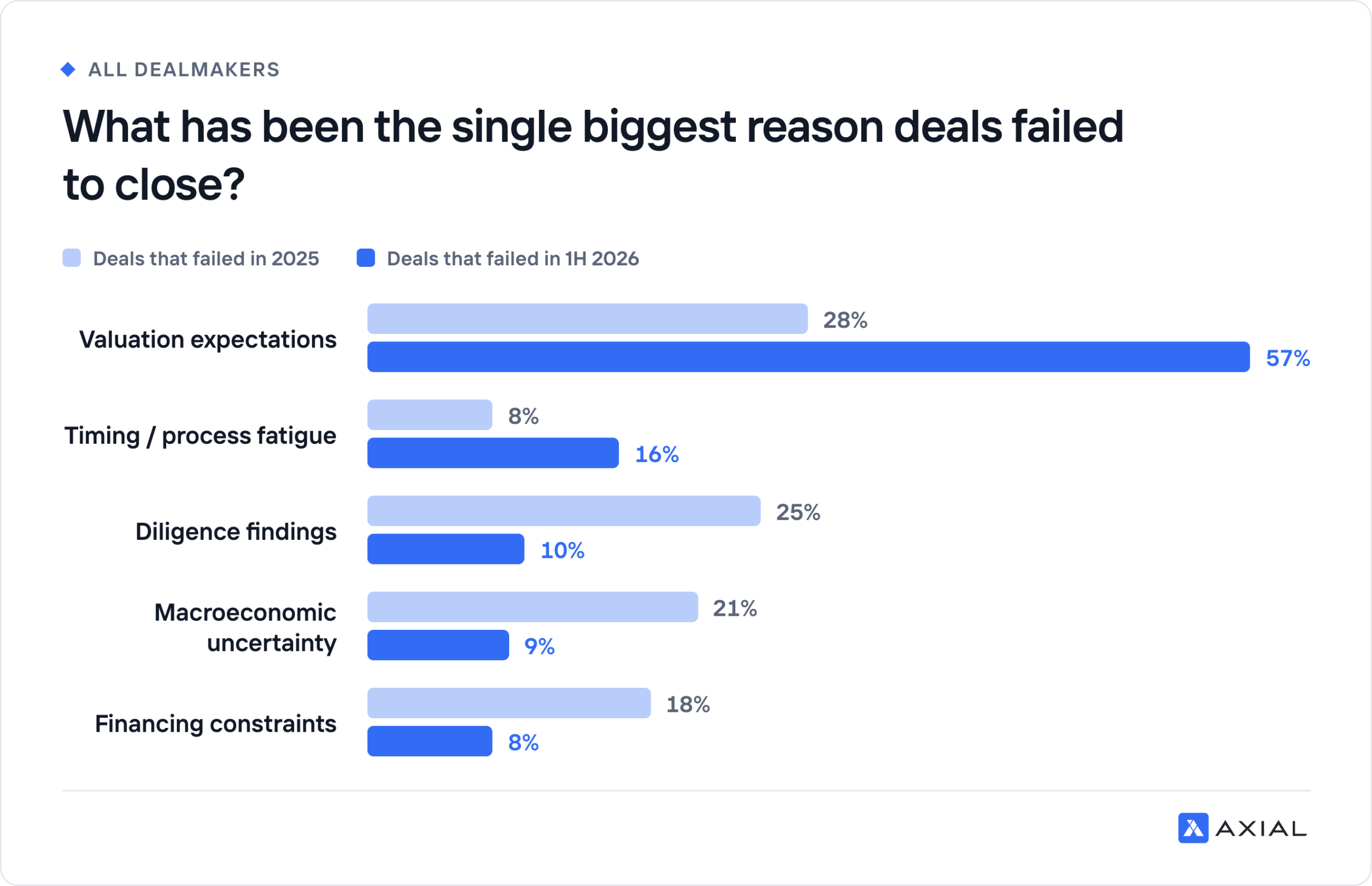
Valuation expectations were cited as the single biggest reason deals failed to close in 1H 2026 by 57% of surveyed Axial dealmakers, more than double the 28% reported for deals that failed in 2025. Timing and process fatigue also doubled, rising from 8% to 16%. Together, these two factors accounted for nearly three-quarters (73%) of responses, compared with 36% for 2025 deals.
Meanwhile, diligence findings declined from 25% to 10%, macroeconomic uncertainty fell from 21% to 9%, and financing constraints dropped from 18% to 8%. Taken together, the findings suggest that reaching alignment on price has become increasingly decisive to getting deals across the finish line.
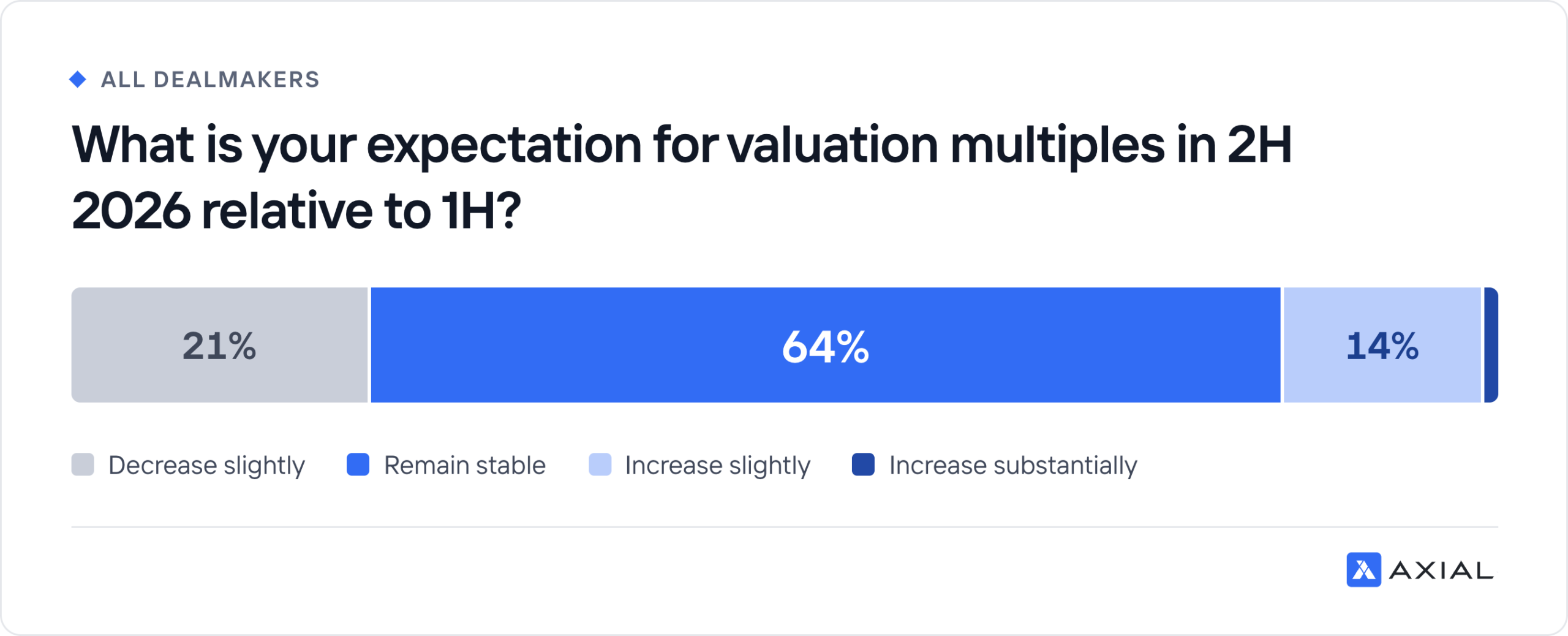
Nearly two-thirds (64%) of dealmakers expect valuation multiples to remain stable in 2H 2026 relative to 1H, while 21% anticipate a slight decrease and 15% expect an increase.
Respondents attributed that stability to counterbalancing forces: competition and limited quality deal flow continue to support pricing, while expensive debt, potential growth in deal inventory, and sellers’ gradual adjustment to the higher-rate environment limit upside. Several also noted that stable headline multiples can mask changes in deal structure, including greater use of seller financing, earnouts, and holdbacks.
The chart below summarizes the outlook, followed by select commentary from surveyed Axial members.
| Member + Firm | Multiples 2H vs. 1H 2026 | Reasoning |
|---|---|---|
| Luke Phenicie, Kissel Capital | Remain stable | The LMM is very competitive - lots of new firms chasing deals, and the supply of quality deal flow has not changed much. I don't expect the 2nd half of 2026 will look much different. |
| Jack Farris, Farris Capital Partners, LLC | Remain stable | If you properly establish a valuation range with your client before you engage, you are much more likely to complete your transaction. Pigs get fat, and hogs get...well, left out in the cold. |
| Charles Scripps, Black Lake Capital, LLC | Increase slightly | Performance has fallen off, but valuation expectations have not decreased. |
| Joe Surber, BluGrowth Partners | Decrease slightly | We are seeing pent-up volume on the sell-side waiting for ‘better market conditions’. At some point, sellers will realize that timing can't be timed and inventory will increase. |
| Van Moody, Lion Business Advisors | Remain stable | Now that interest rates have stabilized at a higher baseline, debt is expensive. Buyers cannot rely on cheap leverage to boost their returns. |
| Rob Kirila, Black Powder Holdings | Decrease slightly | Relative to the past 5 years, we are seeing a slight decrease in broker-advised valuations. ChatGPT has increased the data analysis on both sides of the deals for valuations. |
| Carson Bomar, Exit Game Plan | Remain stable | While headline valuation multiples have remained relatively stable, we've seen a noticeable shift in how deals are being structured. Buyers remain willing to pay reasonable multiples for quality businesses, but they are becoming more conservative with cash at closing. We're seeing increased use of seller financing, earnouts, holdbacks, and other contingent payment structures to better allocate risk between buyer and seller. |
| Rob Chepak, TREP Advisors | Increase slightly | September is a great time to go to market. Private equity buyers are looking for that one last deal to round out the year. |
| Arthur Petropoulos, Hill View Partners | Remain stable | We don't see a change in valuation as much as we see sharpened focus for acquirers. Therefore, there may be fewer participants in certain processes yet more competitive processes amongst the interested parties. Thus, the counterbalancing effect will keep valuations strong. |
| Ali Evans, Metamora Growth Partners | Decrease slightly | I think sellers are still (slowly) coming to accept the new higher rate environment and its impact on valuations (lower willingness to pay by buyers). |
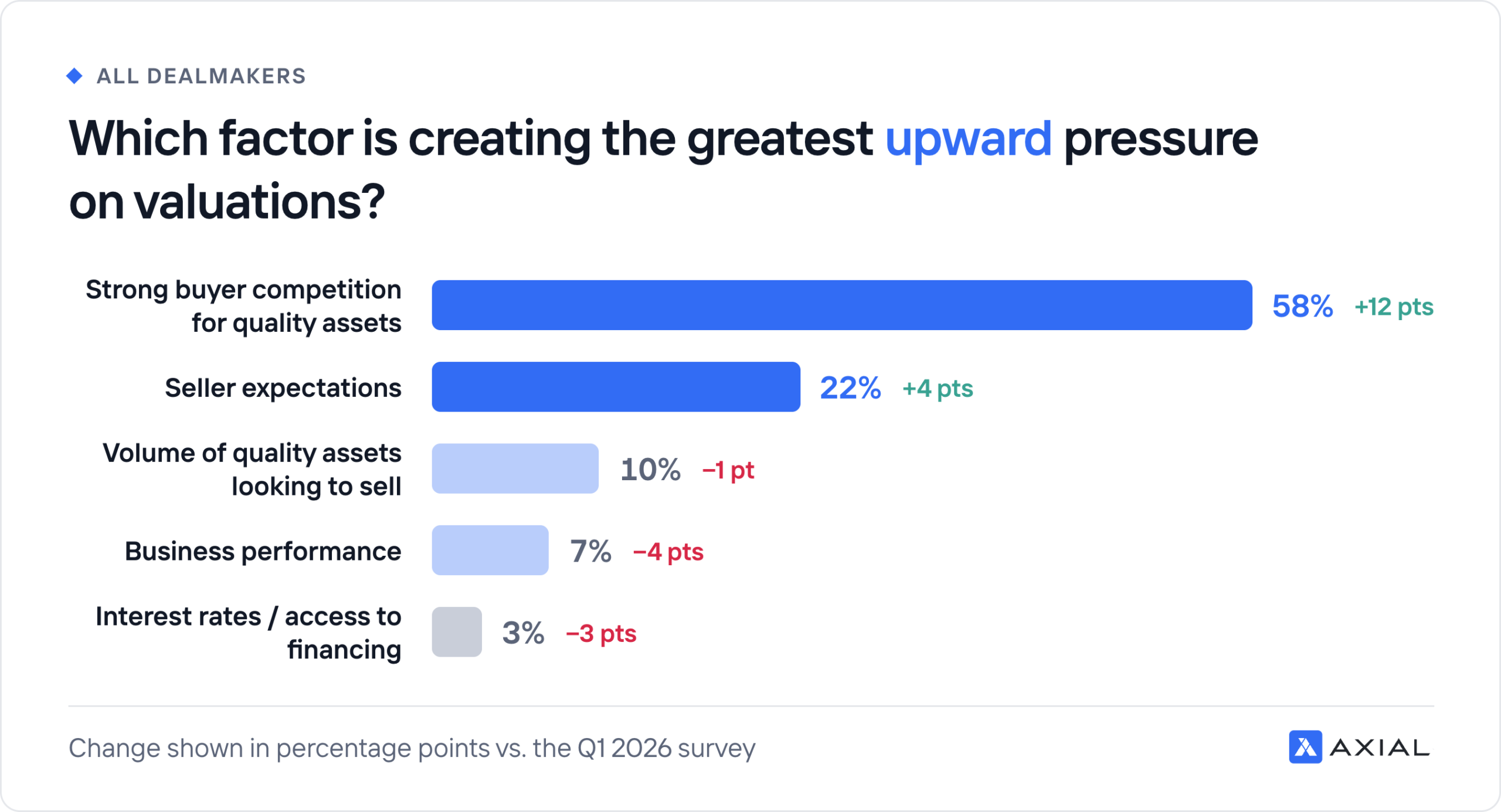
Buyer competition for quality assets has strengthened as the dominant driver of upward valuation pressure, rising 12 percentage points since the beginning of the year to 58%.
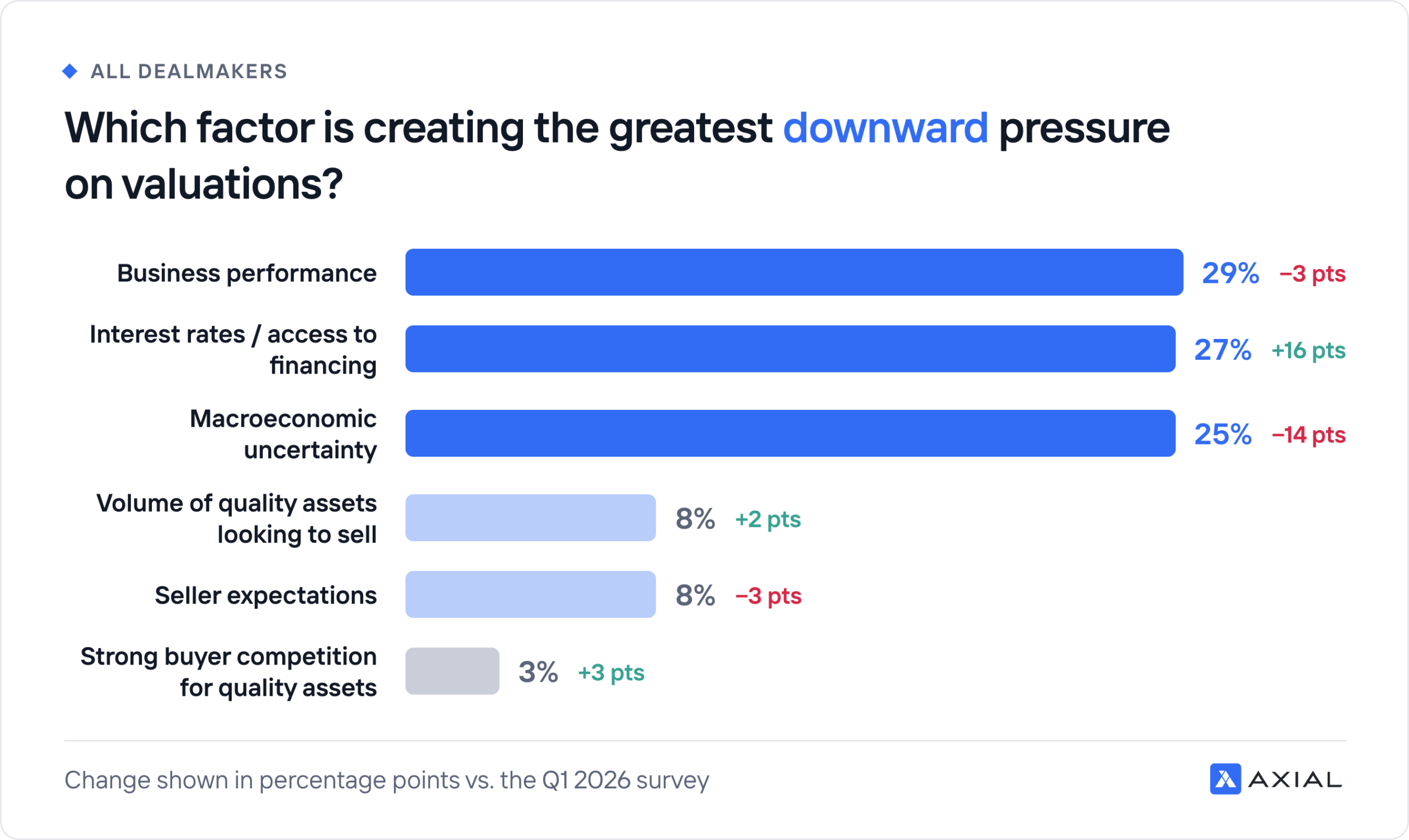
On the downside, business performance remains the leading factor at 29%, while interest rates and access to financing jumped 16 percentage points to 27%. Meanwhile, macroeconomic uncertainty declined 14 percentage points to 25%, suggesting that downward pressure is shifting away from broad market concerns and toward company performance and the cost of capital.
The two charts below show how these factors have changed since the start of the year.
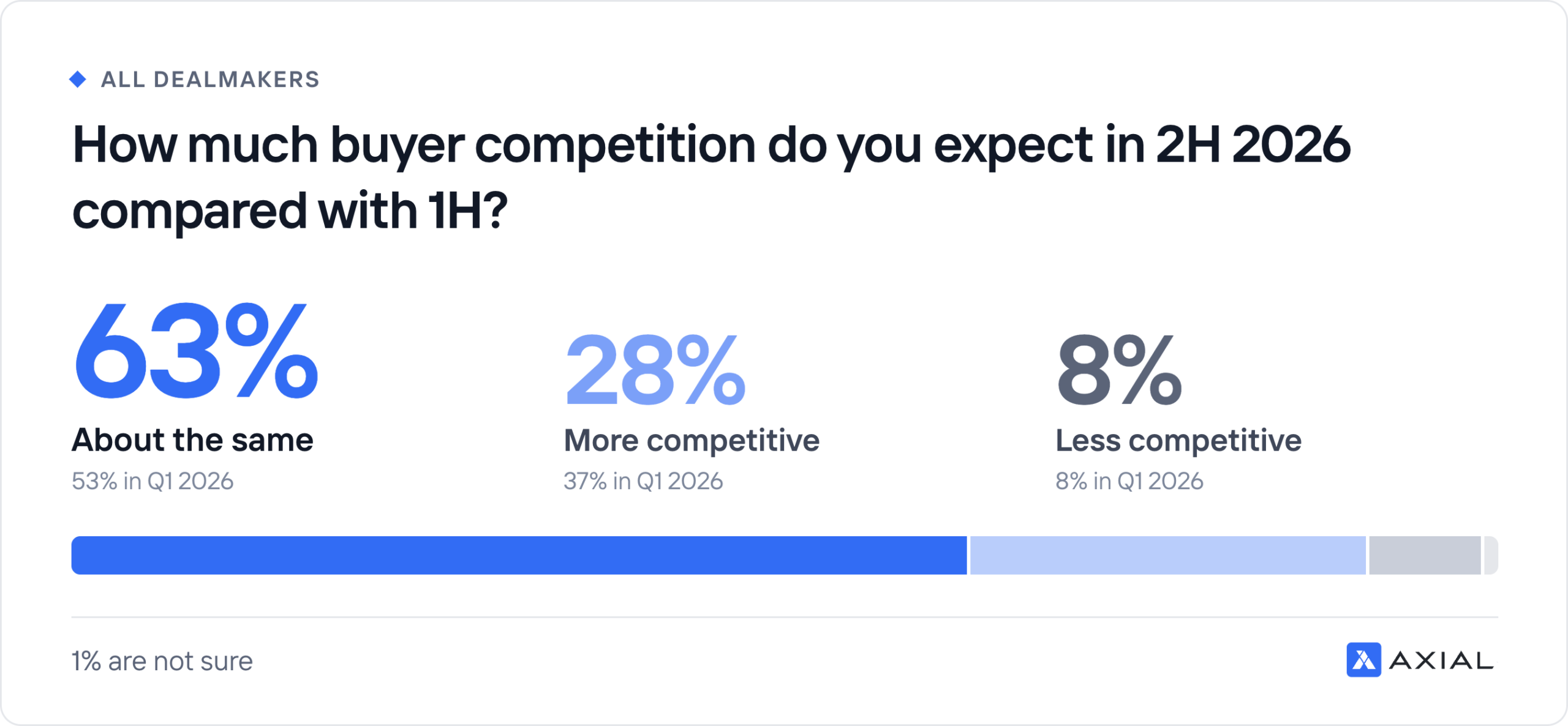
Compared with the start-of-year outlook, the percentage of dealmakers expecting buyer competition to remain steady increased from 53% to 63%, while the share anticipating a more competitive market fell from 37% to 28%. Just 8% expect competition to ease. Overall, 91% expect buyer competition to remain steady or increase, suggesting deal processes will remain competitive at least in the short term.
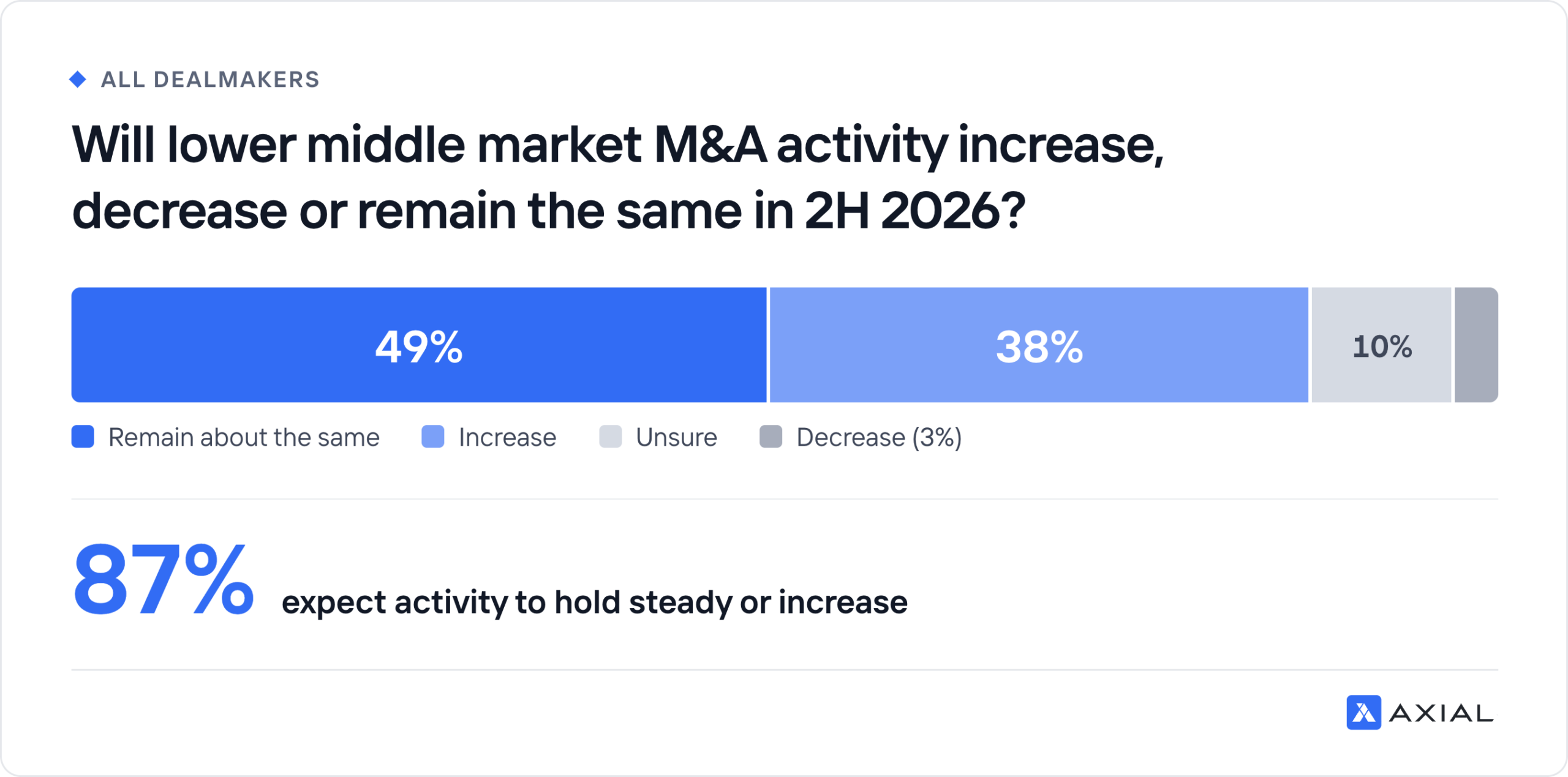
Although valuation expectations emerged as the leading cause of failed deals in 1H 2026, surveyed dealmakers do not anticipate a broad pullback in activity. A combined 87% expect LMM M&A activity to hold steady or increase in 2H, including 38% who anticipate an uptick. Only 3% expect activity to decline.
That outlook is consistent with activity on Axial’s platform, where Q2 2026 deal volume reached a quarterly record, with 3,523 deals coming to market. Axial’s Deal Flow Intelligence Dashboard provides a deeper look at activity across industries, geographies, deal sizes, and time periods.
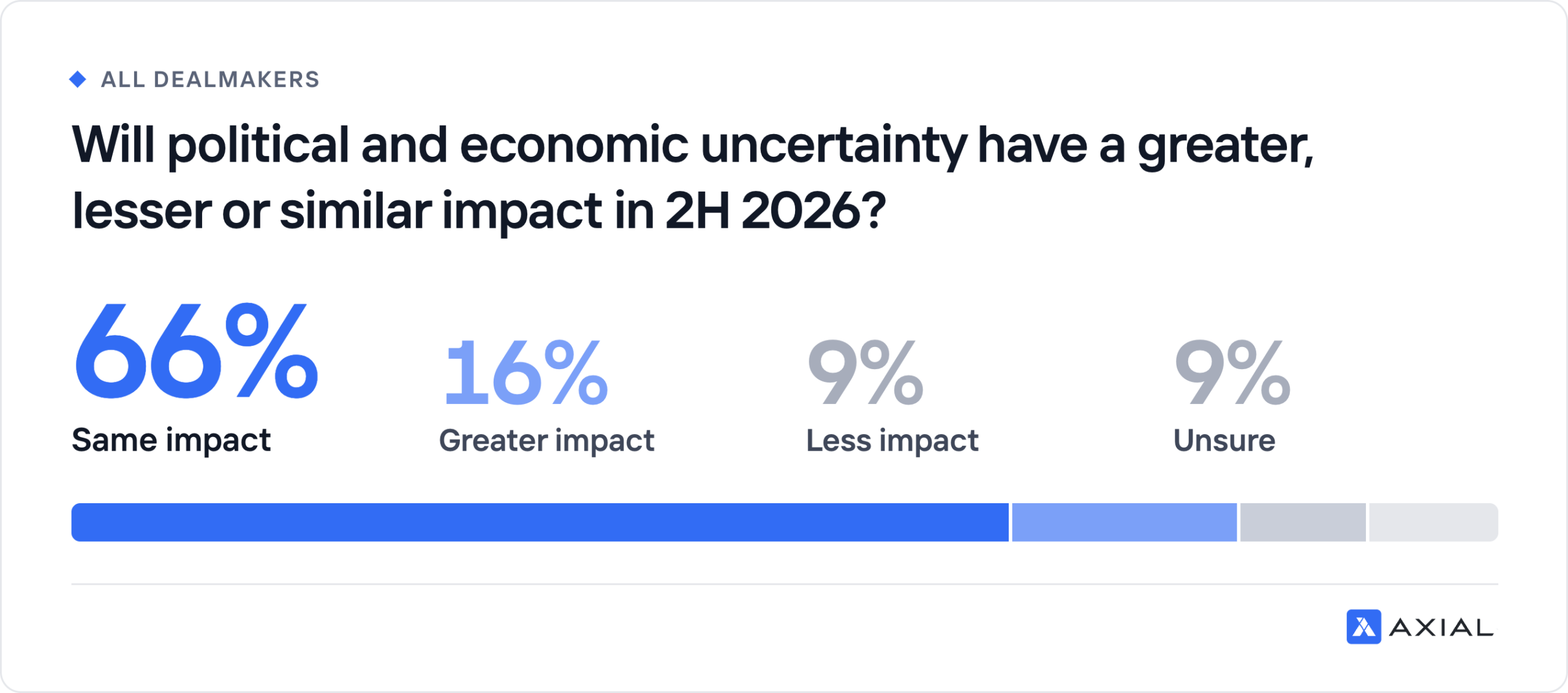
Political and economic uncertainty is expected to remain a consistent presence in the deal market, with 66% of surveyed Axial investors and M&A advisors anticipating the same level of impact as in 1H. Another 16% expect a greater impact, while just 9% foresee less impact.
Member commentary suggests uncertainty has become normalized, but its effects remain uneven across industries and individual transactions. Rather than halting activity, it is making buyers and lenders more cautious, extending timelines, increasing financing and valuation pressure, and narrowing interest toward resilient businesses with clear strategic value. The impact appears greatest in industries exposed to consumer demand, regulation, tariffs, and supply chain risk.
| Member + Firm | Impact in 2H vs. 1H 2026 | Reasoning |
|---|---|---|
| Kristen Bistany, Mangrove Equity Partners | Same impact | We have seen a slowdown in industrial manufacturing opportunities due to lingering uncertainty around tariffs. Blue-collar services and white-collar professional services related deal flow have remained robust. |
| Charles Scripps, Black Lake Capital, LLC | Less impact | We believe that uncertainty around the Iran war and inflation will be lower by year-end. |
| Ali Evans, Metamora Growth Partners | Same impact | The biggest challenge is the lack of regulatory clarity and impact on commodities pricing, which affects supply chains and COGS. |
| Carson Bomar, Exit Game Plan | Greater impact | Political and economic uncertainty is causing many business owners to delay their exit plans rather than accelerate them. Inflation and the rising cost of living have increased the amount many owners feel they need from a sale to fund retirement, while higher interest rates and financing costs have made buyers more disciplined on valuation. As a result, we're seeing longer decision cycles, more emphasis on deal structure, and greater scrutiny during due diligence. Well-positioned businesses with strong recurring cash flow continue to attract quality buyers, but valuation expectations are taking longer to align with current market realities. |
| Neil Johnson, Lawrence, Evans & Co., LLC | Greater impact | Elections typically play a role in healthcare deals as the uncertainty of policy going forward creates time for pause. |
| Michael Vann, The Vann Group | Same impact | I think the market is starting to become comfortable with uncertainty because it's been uncertain for a long time now. |
| Bill Schloth Jr., ASA Ventures Group. | Less impact | From our vantage point, it seems acquirers realize the political and economic uncertainty is almost normal these days. They aren't letting the uncertainty cause deals not to go through. |
| Alan Horwitz, Nonnie Group LLC | Same impact | It seriously creates more risk on both sides. The businesses may not show the expected results, and the buyers are trying to reduce their risk as compared to prior years. |
| Arthur Petropoulos, Hill View Partners | Unsure | Acquirers are looking for things that make strategic sense (i.e., access or capabilities), and are shying away from moonshot ideas/binary outcomes. Therefore, they are more interested in fewer things - resulting in more focused acquisitions that remain competitive if the seller is truly a missing puzzle piece for the acquirer. |
| Rob Katcher, Matter Holdings | Same impact | Concerns of war and the AI bubble bursting make an economic downturn very possible. |
Looking ahead, dealmakers are monitoring a mix of technological disruption, shifting buyer behavior, and evolving seller dynamics. AI emerged as a recurring theme, both as a potential threat to existing business models and as a tool reshaping deal sourcing, analysis, and valuation.
Respondents are also watching the growing separation between high-quality and average businesses, financing availability, succession-driven exits, and the potential effects of the midterm elections, interest rates, and geopolitical developments. The table below features select perspectives from surveyed dealmakers.
| Member + Firm | Quote |
|---|---|
| Jonathan Haski, Floor Plan Inc. | Succession, mainly. Many owner-operated businesses have no obvious successor inside the company, and a long stretch of economic uncertainty makes waiting less attractive than it looked a few years ago. We expect more owners to act on that over the next couple of years. |
| Lane Carrick, Optima Mergers & Acquisitions | The midterm elections, depending on the outcome, may impact both buyer and seller sentiment in a way that will impact supply, demand, or both. |
| Arthur Petropoulos, Hill View Partners | Acquirers are still in the business of allocating capital and must do so. The macroeconomic environment, global wars, etc. will make good companies at a fair price the priority over fair companies at a good price. We expect to see considerable competition for strong assets that solve for the real strategic mapping of acquirers. |
| Michael Vann, The Vann Group | We are continuing to monitor Gen X's approach to exits. |
| Vipin Singh, Murphy Business Sales | The theme of late 2026 is structural discipline. Macro noise is constant, but dealmakers who focus on highly strategic add-ons, tech enablement, and domestic resilience are moving transactions forward at high success rates. |
| Dennis Huang, Polychrome | I am keeping a very close eye on how the public software markets are going to be performing. Is AI really coming for all of software's lunch? Or is there going to be a floor for the Saaspocalypse? |
| Nicholas Lall, Intermountain Succession Capital | Geopolitical issues will probably become more real. The US economy has largely avoided the brunt of them thus far. |
| Carson Bomar, Exit Game Plan | One trend I'm watching closely is the continued separation between high-quality and average businesses. Buyers remain active, but they're becoming increasingly selective. Businesses with recurring revenue, strong management teams, clean financial reporting, and limited owner dependence continue to attract competitive interest, while weaker businesses are taking longer to transact. |
| Kyle Bobinski, Structured Partners | Buyer competition. Buyers have been very hesitant to put money to work in the front half of the year. |
| Rob Kirila, Black Powder Holdings | AI's dramatic impact on the sourcing, vetting, analysis, and valuation of businesses and assets. |
The lower middle market enters the back half of 2026 with interest intact but greater discipline. Most survey respondents expect M&A activity to hold steady or increase and valuation multiples to remain stable, supported by continued competition for quality assets. Yet business performance and financing costs continue to weigh on valuations, while misaligned expectations have emerged as the clearest point of friction and the leading reason deals fail to close.
The central challenge for 2H 2026 is turning that momentum into completed transactions. With political and economic uncertainty increasingly treated as a persistent market condition, those who establish alignment early will likely be best positioned to convert market interest into closed transactions.
Subscribe below to Axial’s Middle Market Review to receive the next installments in the 2H 2026 M&A Outlook Series, featuring a more in-depth look at the perspectives of investors and M&A advisors.
Axial surveyed 79 lower middle market dealmakers in July 2026, including 40 buyers and investors (51%) and 39 sell-side M&A advisors (49%). Of the respondents, 66% worked at firms with fewer than 10 employees, 24% at firms with 11 to 40 employees, and 10% at firms with more than 40 employees.
“All dealmakers” findings combine both audiences, while role-specific findings include only the relevant group. Percentages are based on responses to each question and may not total 100% due to rounding.
Where noted, results are compared with Axial’s 2026 M&A Outlook Report to show how market perspectives have evolved since the start of the year. Results reflect the views of participating Axial members and should be considered directional rather than representative of the entire lower middle market.