The Middle Market Review Insights on the Middle Market.

Thanks for subscribing!

Born in America: The Industries That Founded the Nation, and the Ones Shaping Today’s M&A

In the summer of 1776, the American economy ran on farms, forges, mills, and ships. No software companies. No private equity firms. No healthcare platforms or managed service providers. The people building the young nation’s economy were farmers, ironmasters, and merchants, not the types of business owners you’d expect in an M&A process today.
Nearly 250 years later, some of those same industries remain among the most active corners of the deal market, while others would have been unimaginable to the country’s founders.
This article highlights some of the most important chapters in that story: the industries that built America, the consolidation that reshaped them, the emergence of entirely new sectors, and the businesses whose roots stretch back generations.
As America approaches its 250th birthday, here’s how its industries have evolved over two and a half centuries of entrepreneurship, innovation, and ownership.
America’s Founding Industries
The colonial American economy was defined by what the land provided and what the sea could carry. In New England, shipbuilding was the most profitable manufactured export. Abundant timber, skilled craftsmen, and access to Atlantic trade routes helped make shipbuilding one of colonial America’s most important industries. In the Middle Colonies, fertile soil made wheat and grain a major export. In the South, tobacco defined entire regional economies. Nearly everywhere, agriculture was simply the way most people made their living.
Beyond shipbuilding, manufacturing existed but on a smaller scale. Ironmaking relied on charcoal furnaces that consumed enormous quantities of wood. Textile production happened at home, where nearly every household had a spinning wheel. Milling, timber, fur trading, and fishing weren’t sectors to be screened or sorted. They were the fabric of daily economic life.
What’s notable about this list isn’t how primitive it sounds. It’s how familiar. Strip away the vocabulary, and you’re looking at the ancestors of today’s industrials, food & beverage, building materials, and consumer goods sectors. The same categories still generate thousands of opportunities on the Axial platform each year.
The First Great Consolidation
The founding industries didn’t stay fragmented for long. Between 1895 and 1904, a wave now called the Great Merger Movement swept through the American economy. Roughly 4,000 companies merged into larger enterprises in less than a decade, reshaping industries from steel and railroads to manufacturing and consumer goods. The industries being consolidated were largely the ones that had powered the American economy for generations.
Cornelius Vanderbilt had already shown the playbook: starting in 1869, he acquired and merged railroad lines across New York into what became the New York Central. J.P. Morgan followed in 1901 by purchasing Carnegie Steel for more than $492 million and merging it with nine other steelmakers to create U.S. Steel, the world’s first billion-dollar company. General Electric had been assembled from Thomas Edison’s electric company and several rivals by J.P. Morgan just a decade earlier.
The pattern was the same across industries: fragmentation, competition, consolidation, and dominance. It was consolidation on an unprecedented scale, reshaping American industry before modern antitrust policy emerged. And the companies doing the acquiring were running a playbook similar to what would feel familiar to many financial and strategic acquirers today.
Still Building America
When the industrial revolution accelerated after the Civil War, it didn’t replace the founding economy so much as scale it. Farms became agribusinesses. Craftsmen became factory workers. Timber and iron gave way to steel framing and reinforced concrete.
Those trades never disappeared. They evolved. The blacksmith became the fabricator. The mill became the manufacturer. The local builder became the specialty contractor. What changed were the tools, the scale, and the markets they served.
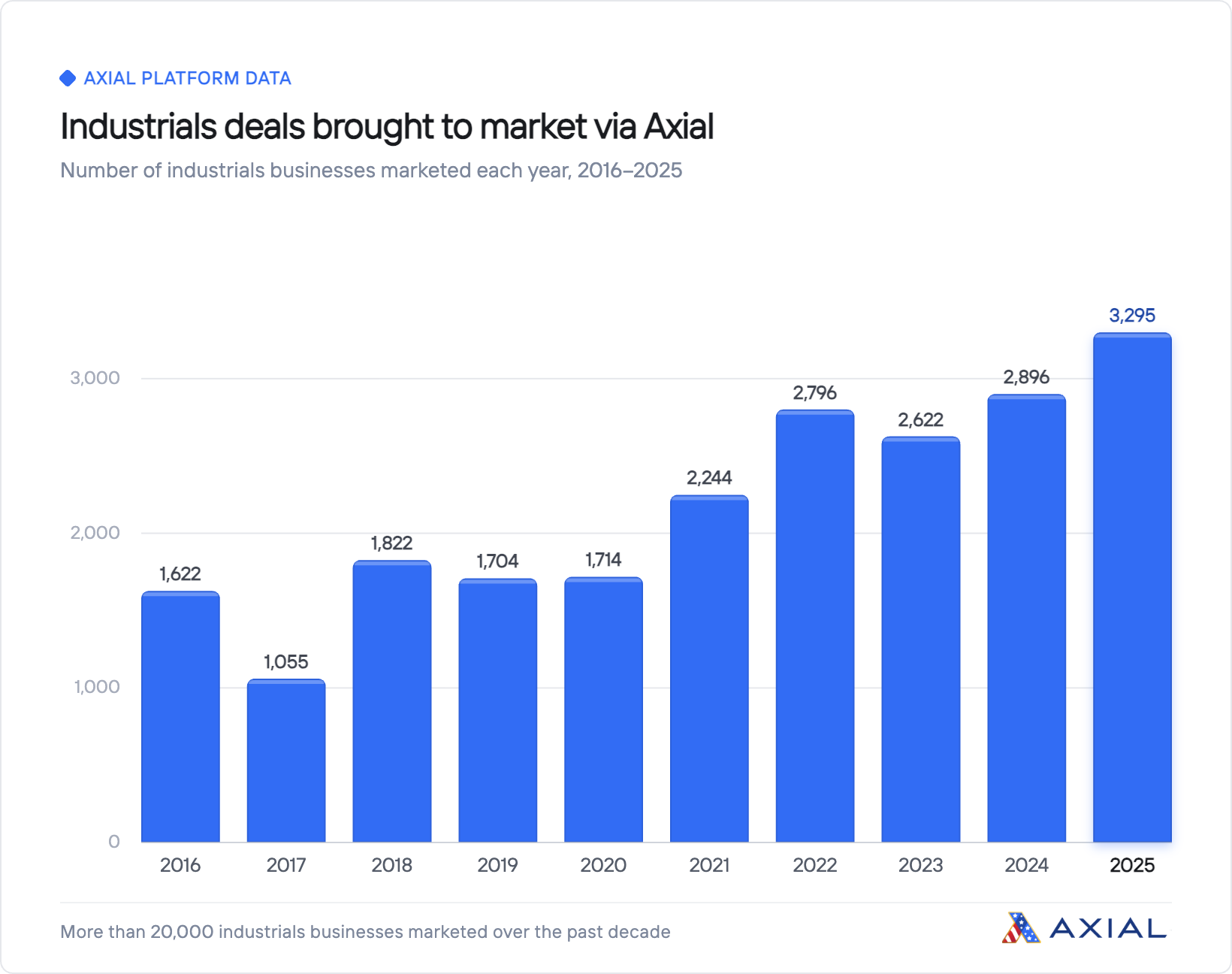
Today, Industrials is the most actively transacted sector on Axial. Over the past decade, more than 20,000 industrial businesses have been marketed via the platform, with the sector accounting for ~40% of all closed deals.
See who is leading Industrials M&A in the lower middle market today: Axial’s Top 50 LMM Industrials Investors & M&A Advisors, 2026
The Industries That Didn’t Exist
Some of today’s most familiar business sectors didn’t exist in 1776. There were no software companies, managed service providers, outsourced business process firms, or AI companies. The American economy has spent the last 250 years inventing them.
The industries that emerged after the nation’s founding were fundamentally different from those that came before. Colonial America’s economy was built around the extraction, production, and transportation of physical goods. As the country industrialized and businesses grew more complex, new sectors emerged to help organizations operate, scale, and compete.
The origins of these industries were different, too. Unlike the sectors that powered the nation’s early economy, these businesses weren’t built around access to land, raw materials, or trade routes. They emerged from expertise, intellectual capital, and the growing complexity of the businesses they serve.
Today, technology, healthcare, and business services are established sectors. Whether it’s a managed service provider supporting critical IT infrastructure, a healthcare platform with specialized systems, or a business services firm helping companies manage compliance and operations, these businesses have become essential parts of the modern economy.
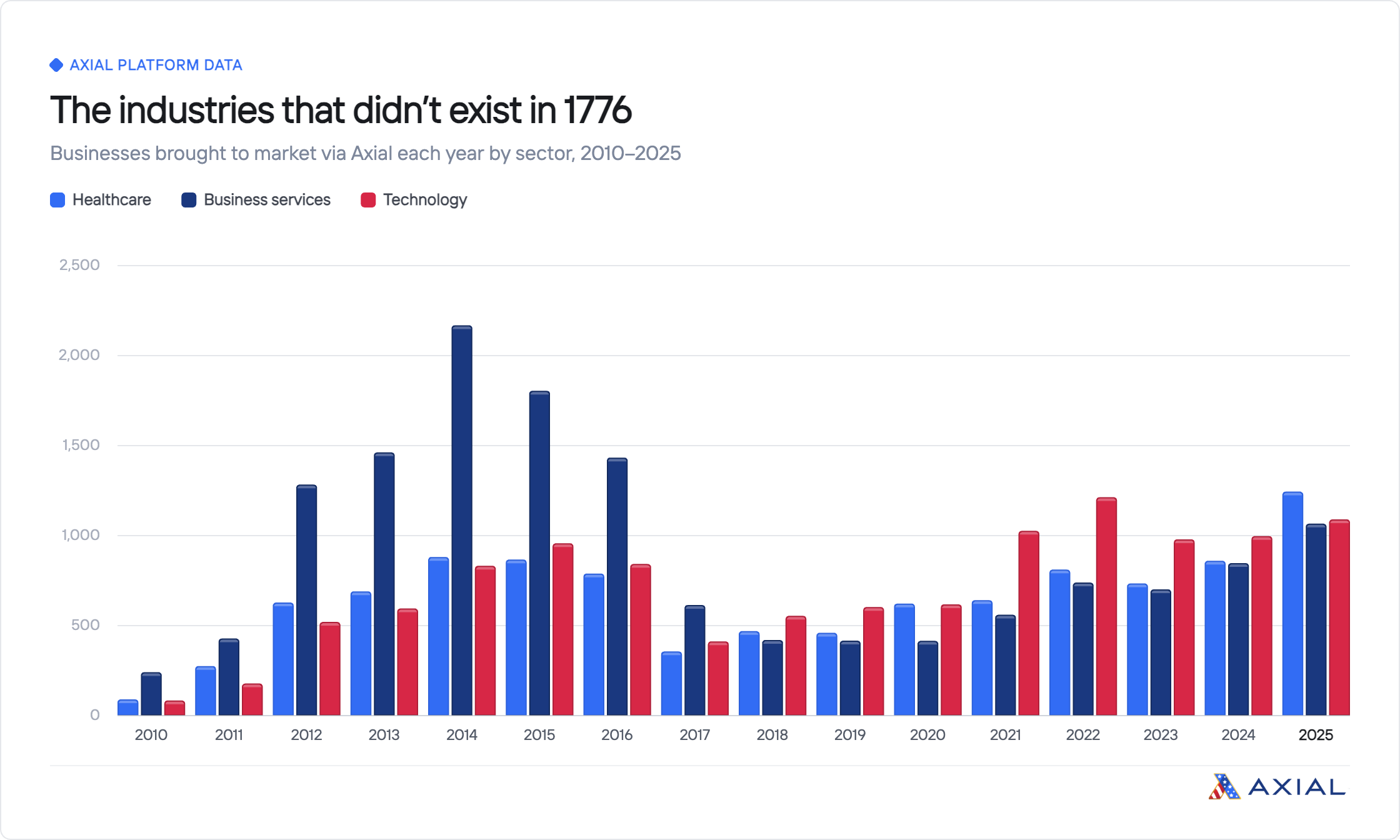
The chart above illustrates how M&A activity across these industries has evolved throughout the history of the Axial platform. Business services experienced particularly strong growth between 2012 and 2016, a period that coincided with increased outsourcing, cloud software adoption, and growing demand for specialized operational support. More recently, healthcare has accelerated, with healthcare businesses brought to market on Axial increasing 24% year-over-year in 2025.
Together, they represent a different chapter of American economic history: one shaped less by what the land could produce and more by what knowledge, innovation, and specialization could create.
America’s Oldest Businesses
The first generation of American entrepreneurs didn’t wait long to get to work. By 1784, Alexander Hamilton had helped found Bank of New York. That same year, D. Landreth Seed Company opened in Philadelphia – the oldest seed company in America, still operating today. Crane & Co., established in 1801, began making specialty paper that would eventually supply the US government with the stock used to print American currency. Colgate was founded in 1806 as a soap, candle, and starch business on Dutch Street in Manhattan.
These weren’t colonial businesses. They were American ones – built after the Revolution, in the first decades of a country still writing its own rules. The industries they operated in, banking, agriculture, manufacturing, and retail, are the same ones that continue to generate significant M&A activity today.
On Axial, the oldest businesses to come to market tell a version of the same story. The table below features businesses brought to market on Axial’s platform, listed chronologically by founding year. Longevity of businesses like these often becomes a prominent part of the investment narrative. A company that has survived the Great Depression, two World Wars, multiple recessions, and a pandemic offers proof of durability across generations of economic change.
| Founded | Business | Sector | Marketed via Aixal |
|---|---|---|---|
| 1866 | Kittinger Furniture Co. | Consumer Goods | 2023 |
| 1873 | Napa Valley Estate Winery | Food & Hospitality | 2023 |
| 1873 | Specialty Chemical Manufacturer | Industrials | 2022 |
| 1879 | 142-Year-Old Chocolate Manufacturer | Consumer Goods | 2022 |
| 1893 | 130-Year-Old Bakery | Food & Hospitality | 2023 |
| 1897 | Metal Conversion Specialist | Industrials | 2021 |
| 1901 | Metal Stamping Manufacturer | Industrials | 2020 |
| 1901 | Wood Product Manufacturer | Industrials | 2021 |
| 1906 | Prosthetic Appliances & Supplies | Healthcare | 2022 |
| 1917 | Canned Vegetables Manufacturer | Food & Hospitality | 2025 |
250 Years of American Business
Two hundred and fifty years after the country’s founding, many of the industries that built the nation remain active today. Others emerged as the country expanded, industrialized, and matured.
When the Declaration of Independence was signed, the American economy ran on farms, forests, shipyards, and furnaces. Today, software firms, healthcare providers, business services companies, and advanced manufacturers share the stage.
Together, they tell the story of an economy that has continuously reinvented itself while remaining rooted in the same entrepreneurial spirit that shaped the country’s early years.
The impulse to build, buy, grow, and pass on a business remains as American as it was in 1776.
Learn More About Joining Axial
Subscribe to Middle Market Review