


Your AI Says Premium. The Buyer’s AI Says Discount. Neither Answer Is the Market.
This is a guest post from Max Friar, Founder and Managing Partner of Calder Capital, an Axial member since 2015…
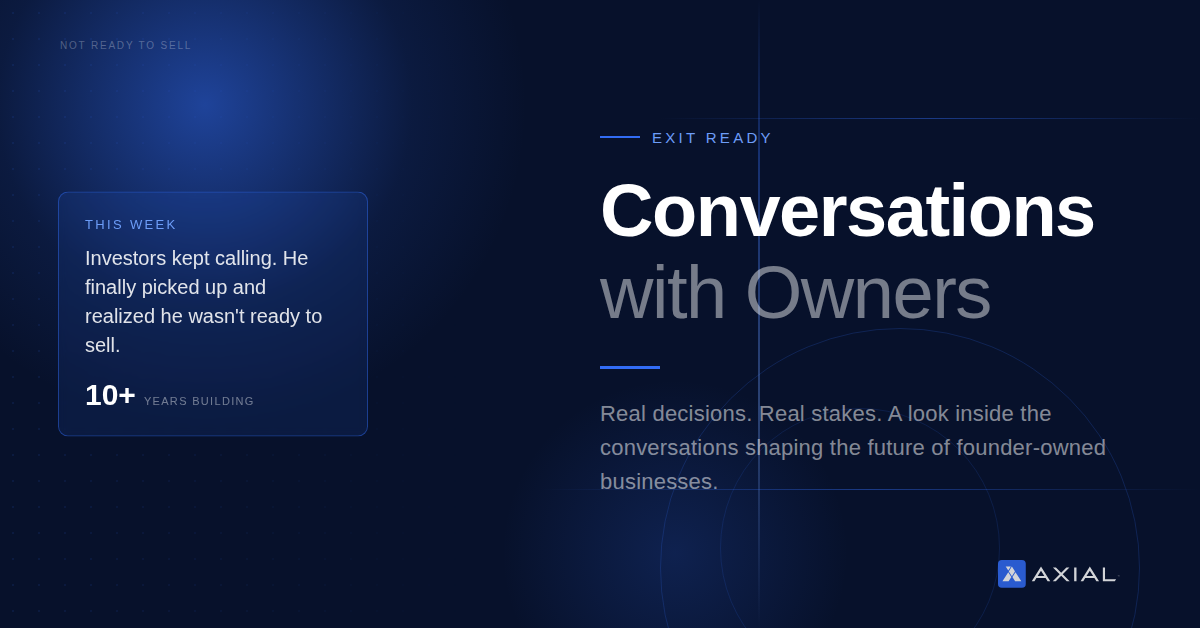
A business owner called Axial after receiving repeated outreach from investors for over a year. When he finally took a meeting with an interested investor, something became clear: he wasn’t ready to sell, but he was ready to explore what capital could do for the business.
That distinction, between reacting to inbound interest and exploring all options through a structured process, changes everything about how a transaction unfolds.
Below is an anonymized recap of the conversation: the questions he asked, the guidance he received, and the insights that will help him move forward on his own terms.
The owner operates a consumer services business that he spent more than a decade building. With the company on solid footing and positioned for continued growth, he wasn’t looking for an immediate exit. But after receiving consistent interest from investors, he began exploring whether outside growth capital could help achieve his long-term goals more quickly.
He outlined two potential paths, both aimed at accelerating the management build-out, scaling through strategic acquisitions, and making the business less dependent on him. One was a minority investment, capped at 20% because of SBA covenants. The other was a joint venture in which an investor financed acquisitions directly. In both cases, the appeal was the same: the company could absorb acquired volume without adding proportional overhead, positioning it for a larger exit within five years.
He believed the company stood apart from typical operators in the industry due to its premium market position, strong margins, proprietary technology, owned real estate, and extensive industry relationships. Just as importantly, he wasn’t under pressure to transact.
| Dimension | Profile |
|---|---|
| Financial Profile | Revenue: $5M - $20M | EBITDA $1M - $5M |
| Primary Objective | Minority investment or joint venture to accelerate management build-out and strategic acquisitions |
| Secondary Objective | Position the business for an exit in three to five years |
| Decision Style | Deliberate, consultative, values input from advisors and peer network |
| Timing Posture | No urgency, willing to move forward only if terms are favorable |
| Advisor Commitment | Open to evaluating advisors, no prior engagement |
| Advisors Spoken To | None, though he has an attorney and accountant advising informally |
| Ideal Process | Evaluate multiple advisors and avoid reactive decision-making |
| Primary Concern | Maintaining control while exploring capital options |
| Alternative Strategy | Continue organic growth without outside capital |
He was concerned that his company might be too small for institutional investors, particularly if he was only offering a minority stake. We explained that the business had several characteristics that could make it attractive despite its size, including strong economics, differentiated capabilities, and future growth potential.
We also noted that family offices often operate with more flexibility than traditional private equity firms. They can structure deals around smaller initial investments if they see a path to deploying more capital over time.
He explained that his SBA financing restricted him from bringing in a minority investor above 20 percent without triggering additional approvals and potentially requiring new guarantors. We confirmed that this was a common constraint for businesses with SBA debt and that it would need to be factored into any term sheet. However, we also noted that 20 percent could still represent meaningful capital if the valuation was structured correctly, and that some investors might be willing to structure a two-stage transaction: an initial minority investment now, followed by a larger buyout once the SBA debt was refinanced or paid down.
We walked him through the typical structure: a monthly retainer or upfront engagement fee, plus a success fee based on the amount of capital raised. We also offered to benchmark any engagement letters he received against hundreds of others we had seen in the market, so he could evaluate whether the terms were competitive.
He had taken one meeting reactively, because the investor was persistent, not because he had decided it was the right time. We explained that inbound interest, while flattering, often puts the business owner in a weaker position. The investor sets the timeline, frames the conversation, and anchors the valuation. A better approach is to work with an M&A advisor and run a structured process that gauges interest from multiple investors. That way, the owner controls the terms and the timeline.
While he had identified two possible structures, he hadn’t fully evaluated the trade-offs. An advisor could help model both paths and determine which best aligned with his goals. Structure isn’t just a legal question. It shapes control, tax treatment, and exit outcomes.
He assumed he would need a local broker. We explained that for a business of his size and profitability, geography was less important than sector fit. The right advisor would be someone who had raised capital for service businesses with recurring revenue, who understood how to position a platform for a roll-up, and who had relationships with relevant investors. That expertise could come from anywhere.
He was worried that his business wouldn’t meet the minimum check size that most investors required. We explained that check size is a proxy for deal complexity and return potential, not a hard rule. His business had the attributes to make it attractive despite its size. The question wasn’t whether he was too small. The question was whether he could articulate why his business was a better platform than other businesses of similar size.
He mentioned that he was part of a CEO peer group. We encouraged him to use this peer group as a sounding board as he evaluated advisors and raised capital. Owners who have been through the process can often provide practical feedback on advisors, deal structures, and negotiations that complement professional advice.
The conversation reinforced the owner’s conviction to move forward with a capital raise. As an immediate next step, he expressed interest in exploring advisor options through Axial’s Advisor Finder program while staying in the information-gathering stage. He acknowledged that having these conversations now would give him a sense of who could represent his business as he prepared for the capital raise.
Inbound interest from a single investor can create a false sense of leverage. While it validates demand for a business, owners who engage without a structured process often find themselves reacting to investor timelines and assumptions. True leverage comes from maintaining alternatives and creating competition.
If you’re curious what investor demand looks like for your business, you can request a Buyer Demand Report, where Axial measures your company against the investment criteria of more than 3,000 active buyers.
Investors don’t automatically recognize platform potential. Owners need to clearly articulate why their business is positioned for growth and support that case with evidence. An advisor can help refine and validate that narrative, but it starts with the owner understanding what makes the business strategically valuable, not just operationally strong.
Financing constraints can complicate a transaction, but they rarely make one impossible. The key is identifying those constraints early so investors and advisors can structure around them.
Exploring capital doesn’t have to mean pursuing a sale. Whether through a minority investment, joint venture, recapitalization, or an outright exit, owners are best positioned when they evaluate options before an investor dictates the process. And if you’ve been weighing whether to raise capital or sell outright, this framework walks through the internal and external signals that suggest when it might be time to sell.
Axial helps business owners explore their options and connect with M&A advisors who specialize in their size, industry, and transaction goals.
For founders who want to better understand their company’s potential value or evaluate whether selling is the right move, the first step is often just a conversation.