


The Advisor Finder Report: Q2 2026
Welcome to the Q2 2026 issue of The Advisor Finder Report, a quarterly publication that surfaces the activity occurring on…

For most business owners, deciding whether to sell is inseparable from deciding when to sell.
Wait too long, and you risk losing momentum, missing a favorable market, or encountering an unexpected personal or business challenge. Move too early, and you may leave meaningful value on the table – or sell before you are personally ready for what comes next.
There is no single age, revenue threshold, valuation multiple, or market signal that tells an owner it is time. The right moment usually emerges from the intersection of three forms of readiness:
These factors rarely align perfectly. Nor do they need to.
The goal is not to wait until every box is checked. It is to understand where you stand, what could improve with more time, and whether the potential benefit of waiting outweighs the risk.
Exit decisions are often framed as financial decisions.
In practice, they are almost always more personal and multidimensional.
Below are the reasons cited by business owners who hired an M&A advisor through Axial over the last two years. Owners could cite more than one reason, and many did.
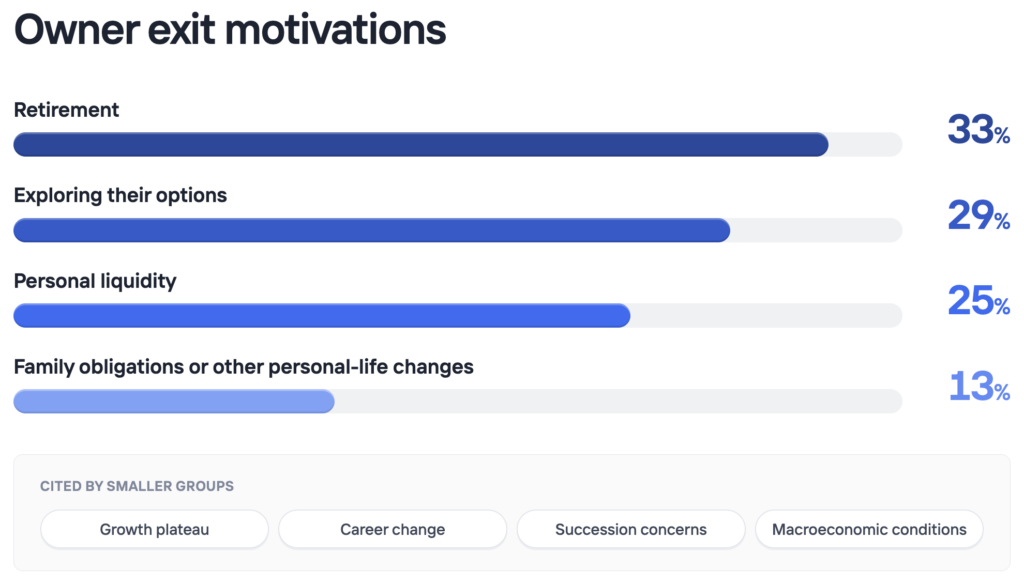
Most owners do not wake up one morning because a single metric has crossed a predetermined threshold. More often, several factors gradually begin pointing in the same direction.
The business may be performing well, but the owner is no longer energized by the work. The owner may want liquidity, but the company still has considerable room to grow. Buyer demand may be strong, but the management team may not yet be prepared to operate without the founder.
Devising your exit timeline is the process of evaluating those signals together.
Before determining whether the company is ready to sell, an owner should understand what they need the transaction to accomplish.
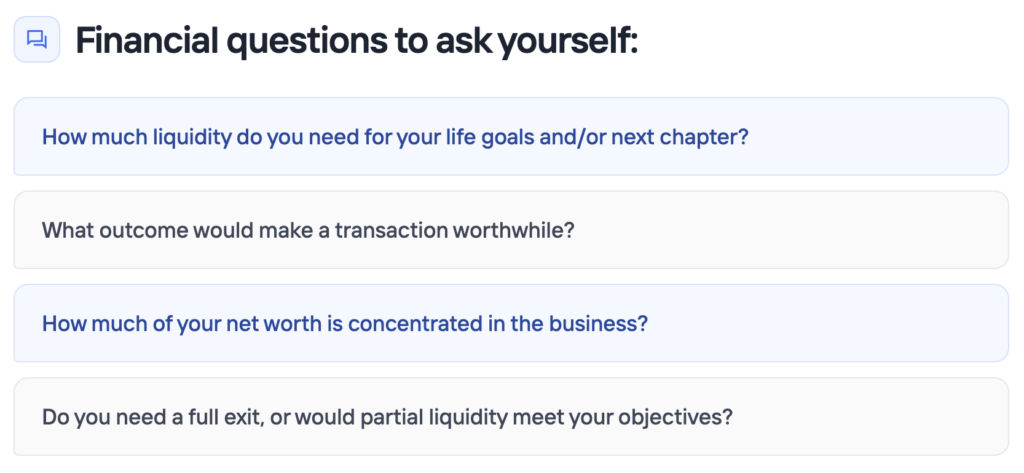
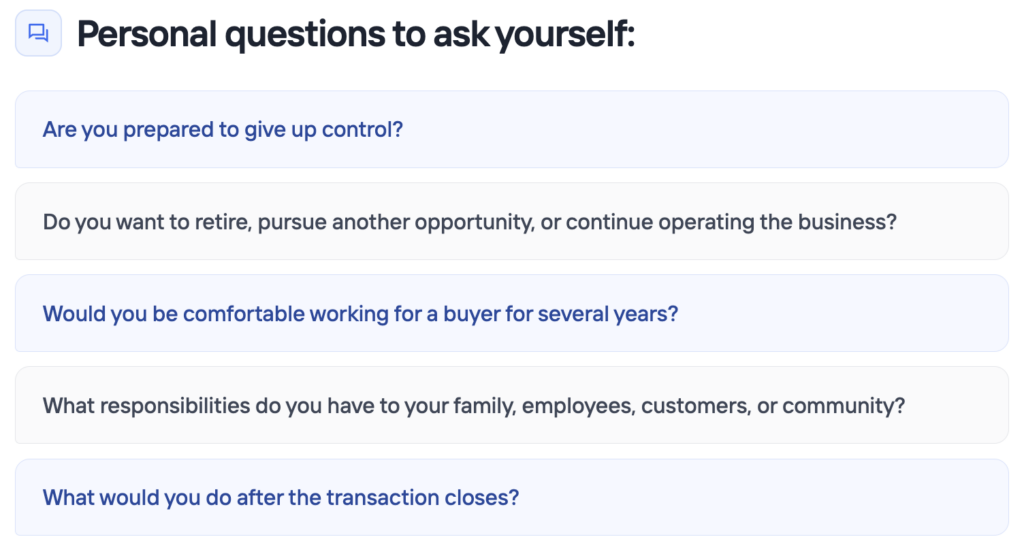
Many owners have spent decades organizing their lives around the business. Their identity, relationships, routines, and sense of purpose are tied to it. A financially successful transaction can still feel unsuccessful if the owner has not thought seriously about life afterward.
Personal readiness does not mean eliminating every uncertainty. It means understanding your objectives well enough to evaluate the tradeoffs.
Owners also need to clarify what they are optimizing for in the transaction itself.
Four priorities tend to matter most.
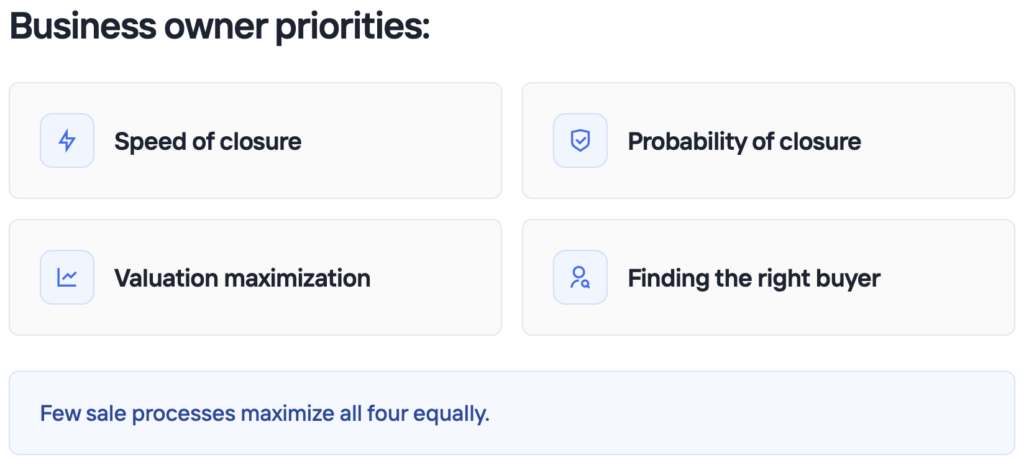
The process that yields the highest price may not be the most likely to close. The fastest route may not create the broadest competition. The best long-term home for employees and customers may not produce the highest headline valuation.
An owner who prioritizes speed and is ok with selling at a 20-40% discount will make different decisions from one willing to run a longer, more competitive process to maximize valuation and likelihood to close. An owner focused on legacy, culture, or employee continuity may define the “best buyer” differently from the owner focused primarily on price.
Clarifying these priorities helps determine how the company should approach the market, and what kind of support the owner may need.
Some owners begin by engaging directly with an inbound buyer. Others decide that their objectives require a structured process and professional representation.
The more an owner cares about buyer competition, valuation, confidentiality, negotiating leverage, and managing execution risk, the stronger the case may be for hiring an M&A advisor.
Owners tend to think about their companies through the lens of history.
Buyers are primarily underwriting the future.
They want to understand the durability, transferability, and risk of the company’s earnings. That makes business readiness less about reaching a particular size and more about the quality of the business beneath the headline numbers.
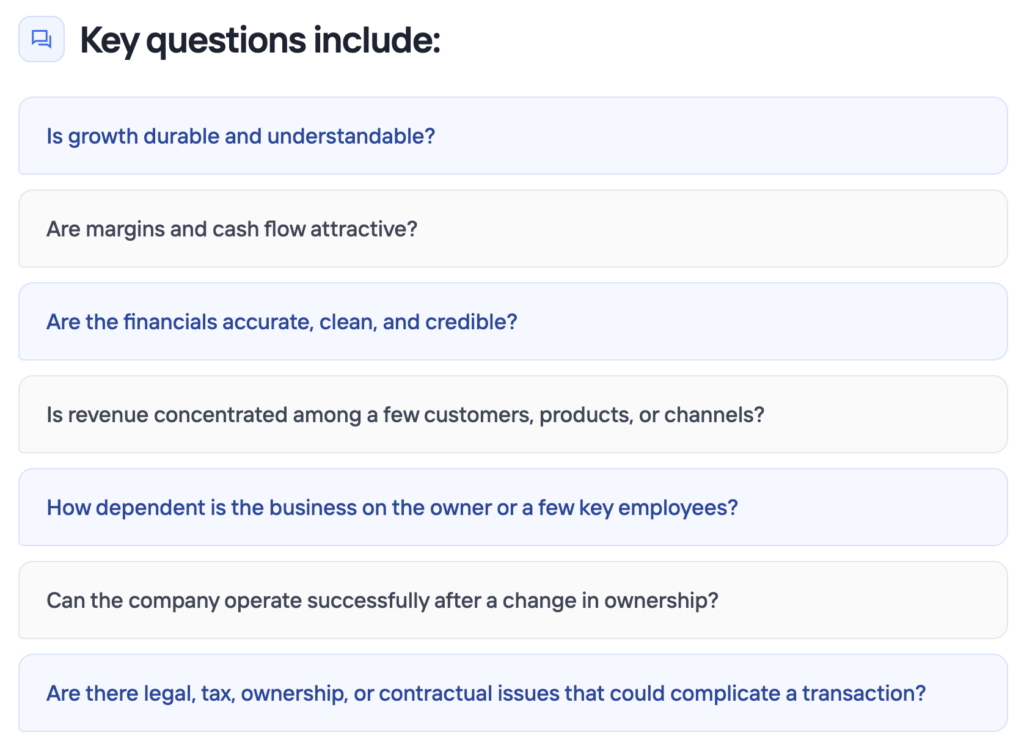
A company does not need to be flawless. Many attractive businesses have customer concentration, owner dependence, uneven growth, or unresolved operational issues. What matters is whether those risks are understood, manageable, and appropriately reflected in the company’s value and transaction structure.
Some readiness improvements can materially change an outcome. Building a management team, reducing concentration, improving financial reporting, or creating a stronger record of recurring revenue may expand the buyer universe and increase valuation.
But those changes take time. That is why owners benefit from assessing readiness well before they feel certain they want to sell.
Even a well-prepared company can experience different outcomes depending on the market in which it is sold.
Interest rates, credit availability, industry performance, buyer confidence, and the supply of comparable businesses can all influence demand.
But the more important question is not whether “the market” is strong. It is whether credible buyers are actively seeking companies like yours.
A strategic acquirer may place a premium on your customers, geography, employees, technology, or capabilities. A private equity firm may see your company as a platform investment. Another buyer may value it primarily as an addition to an existing portfolio company.
The same business can therefore be worth different amounts to different buyers.
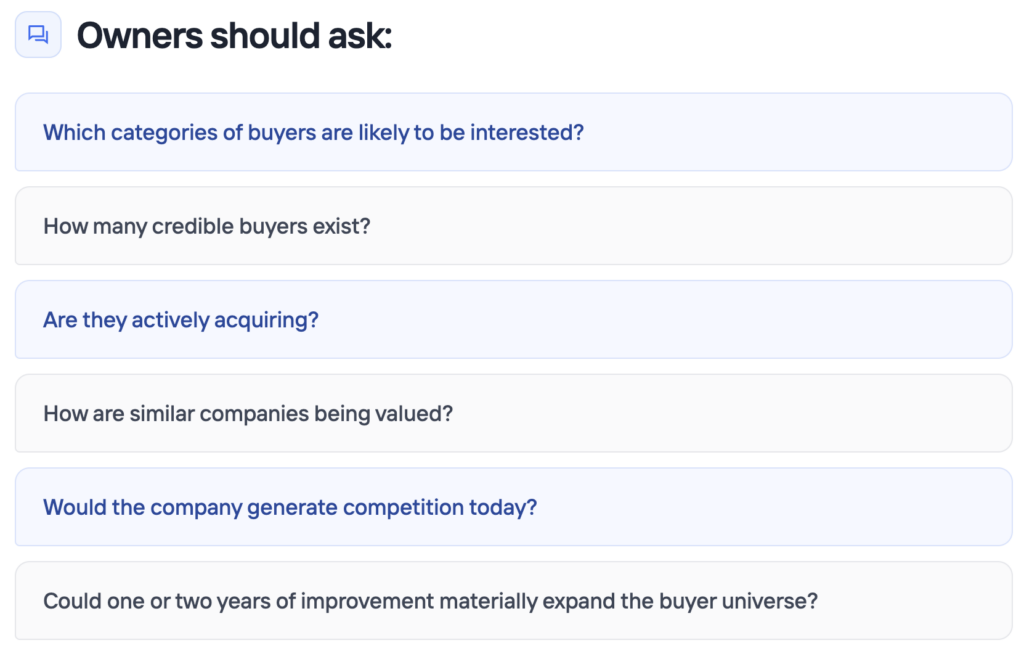
The answers may support going to market now. They may also reveal that the company would benefit from more preparation. Either conclusion is useful.
Owners do not need to become M&A experts before evaluating an exit. But they do need enough context to understand the decisions in front of them.
A full sale is only one option. Depending on the owner’s goals and the company’s circumstances, other paths may include a partial sale, recapitalization, management buyout, employee ownership transition, or a family succession.
An advisor typically helps prepare the company for market, develop positioning and marketing materials, identify and contact buyers, create competition, manage indications of interest, negotiate terms, coordinate diligence, and help keep the transaction moving toward closure.
Most importantly, they help owners prevent deal breakages through strong preparation; create favorable deal structures & terms through strong negotiation; maximize valuation through a strong, competitive process; and signal seriousness to every buyer they interact with.
Advisors also charge meaningful fees. Most advisors charge a retainer, in addition to a 2% to 6% success fee if the business sells.
In exchange for those fees, studies show that M&A advisors generate anywhere from a 10% to 40% higher purchase price relative to going at it alone.
As a result, fees should be evaluated against the potential impact on valuation, transaction terms, probability of closing, confidentiality, and the time the owner would otherwise spend managing the process.
A typical process may include preparation, buyer outreach, management meetings, initial offers, negotiation, diligence, legal documentation, and closing. The entire process usually takes 6-24 months and places significant demands on the owner and management team.
Basic education does not determine whether the time is right. It gives the owner enough context to assess readiness intelligently.
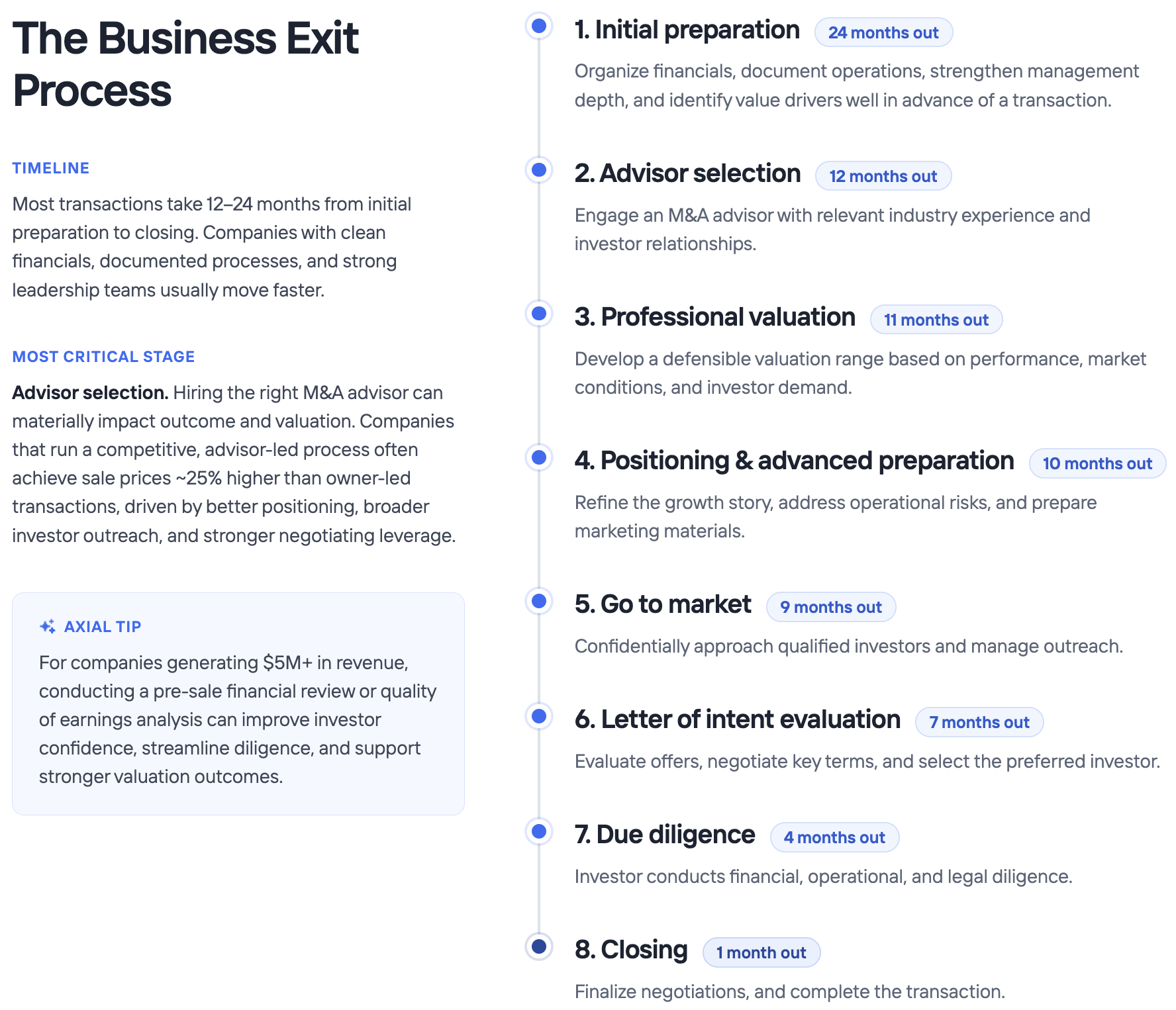
Once an owner understands their personal, business, and market readiness, the decision often comes down to a simpler question:
Waiting can create enormous value.
An additional year or two may allow the company to reach a new scale, complete an important growth initiative, strengthen margins, diversify its customer base, build a management team, or establish a longer track record of recurring revenue.
These changes can increase earnings, improve the valuation multiple applied to those earnings, or both.
Consider an owner whose company generates $3 million of EBITDA and might attract a five-times multiple today, implying a $15 million enterprise value.
If the owner has a credible plan to grow EBITDA to $4 million while reducing owner dependence and customer concentration, the business might eventually attract both higher earnings and a stronger multiple. At six times EBITDA, the implied enterprise value would be $24 million.
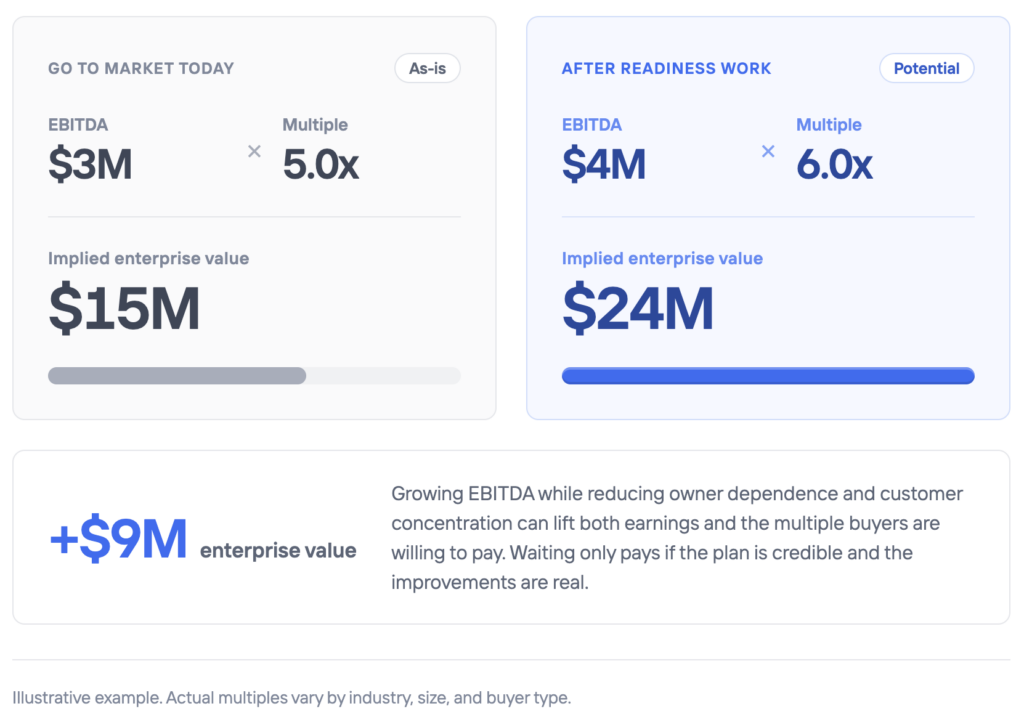
That is a meaningful argument for waiting.
But it is only compelling when the path is credible.
“Another few years of growth” is not an exit plan. A credible value-creation plan has specific initiatives, accountable leaders, realistic timelines, and measurable milestones.
The decision to wait should also account for the risks of continued ownership:
There is no risk-free path.
Selling today exchanges uncertain future upside for greater certainty and liquidity. Waiting preserves the potential for a better outcome while extending the owner’s exposure to business, market, and personal risk.
One of the most consequential mistakes owners make is assuming that exit preparation should begin only after they have decided to sell.
By that point, many of the highest-value improvements may no longer be practical.
Building a management team, reducing customer concentration, cleaning up financial reporting, resolving ownership questions, and establishing a consistent performance record can take years.
Preparation does not obligate an owner to transact. It creates optionality.
An owner who begins preparing early can still decide to operate the company for another five years. We recommend owners start the planning work about ~1,000 days before they ideally want to sell. This allows them to establish a clearer understanding of the company’s value, risks, buyer universe, and priorities early enough for strategic changes to materialize.
The opposite approach – waiting until a sale becomes necessary – often forces owners to make irreversible decisions under pressure.
The best time to understand your options is before you need to exercise them.
An experienced M&A advisor can help an owner evaluate timing before formally launching a sale process.
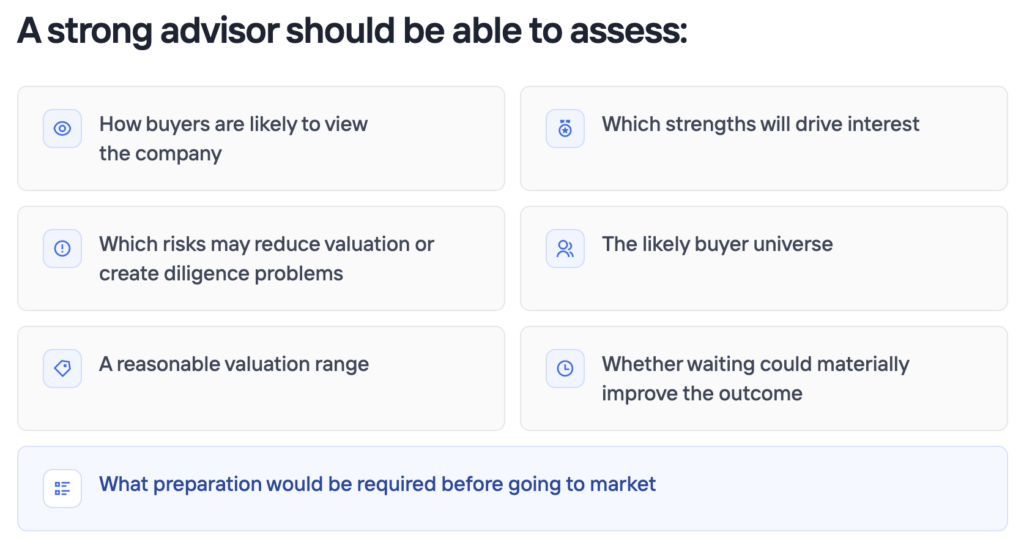
Importantly, the right answer is not always to sell immediately.
A credible advisor should be willing to tell an owner that the company would benefit from another year of preparation – or that the owner’s goals are unlikely to be met in the current market.
The objective of an early conversation should not be to manufacture urgency. It should be to replace assumptions with informed judgment.
Axial for Owners helps business owners understand their options, prepare for an eventual transaction, and evaluate if an experienced M&A advisor is the right partner for their objectives.
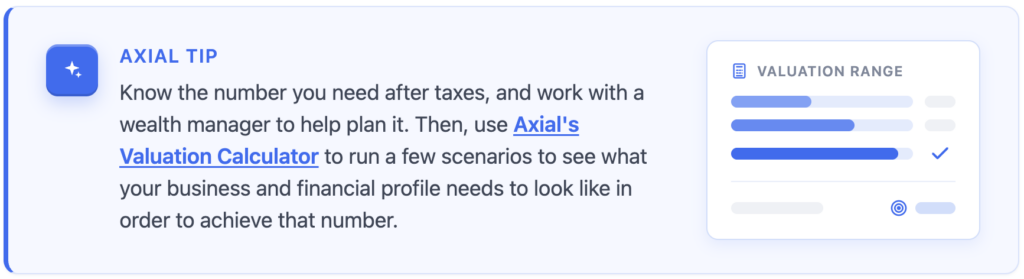
For owners still evaluating timing, that can mean developing a clearer view of what the business may be worth, how much buyer demand may exist, which readiness gaps matter most, and whether hiring an advisor is appropriate now or later.
For owners who decide to explore a transaction, Axial’s Advisor Finder helps them run a competitive search for advisors with relevant industry experience, transaction history, buyer relationships, and fee structures.
The purpose is to help owners approach the decision deliberately – with better information, credible advice, and enough time to choose rather than react.
It is tempting to believe that the right exit date will eventually become obvious.
The company will reach the right size. The market will peak. The management team will be complete. Your personal plans will become clear. A buyer will appear with the right offer.
Sometimes that happens.
More often, owners make the decision while several important questions remain unresolved.
The standard should not be perfect readiness. There should be sufficient alignment among the owner, the company, and the market – and a clear-eyed assessment of the value and risk of waiting.
You do not need to decide today that you are going to sell.
But you should understand what would need to be true for selling to become the right decision.
And you should begin asking those questions early enough that, when the time comes, the choice is still yours.