The Middle Market Review Insights on the Middle Market.

Thanks for subscribing!

250 Deals, Breakups, Buyouts & Consolidations That Shaped American M&A

A note from Peter Lehrman, Founder & CEO, Axial.
July 4, 2026 marks 250 years since the most historically important M&A transaction announcement in modern history. America’s founding was itself a hostile corporate spinoff, filled with its own major M&A moments and metaphors.
250 years later, we owe a great deal to those brave 13 subsidiaries. Despite their many flaws and mistakes, they invented and defended a new form of human governance that has gone on to create more peace, progress, and human prosperity than they could have ever imagined.
In honor of America’s 250th birthday, we are publishing a series of special articles that seek to study the history of M&A in America, its importance in the development of our economy, and its many high highs and low lows.
The article below is the first piece in Axial’s USA 250 M&A Series.
Some of America’s most influential businesses weren’t built through organic growth alone. They were also shaped by the mergers, acquisitions, buyouts, and consolidations that transformed industries and redefined competition.
Across more than two centuries, M&A has helped create industrial giants, accelerate innovation, and reshape the American economy.
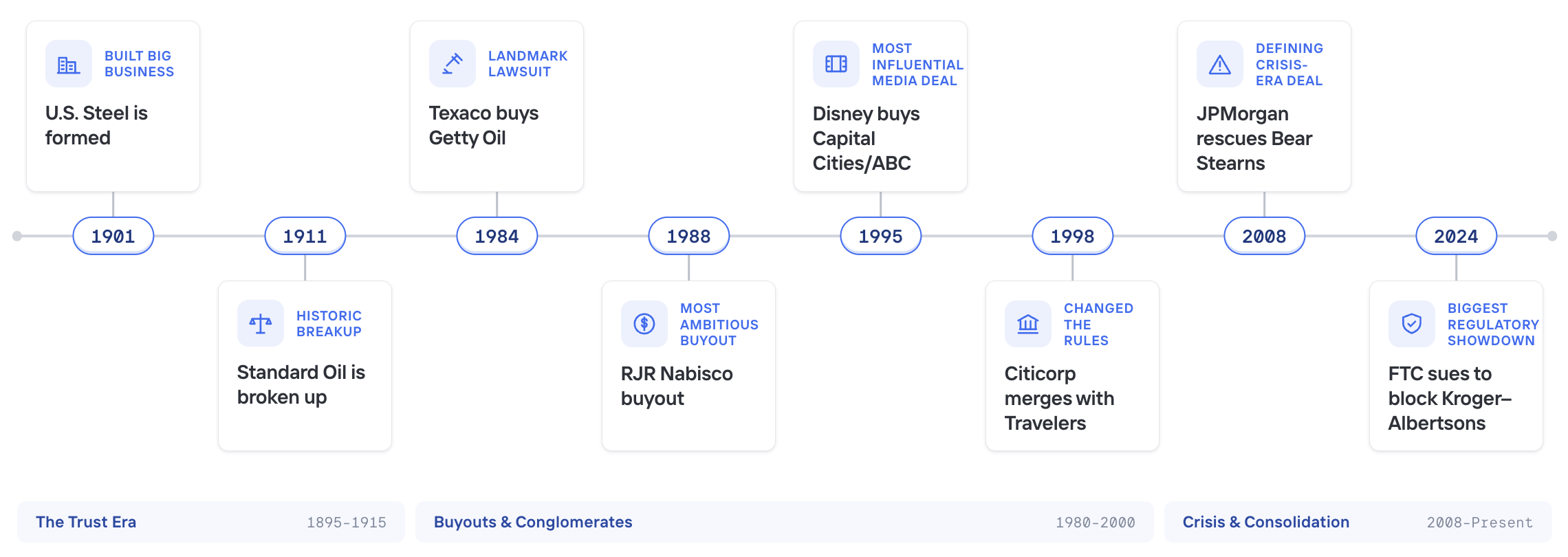
To commemorate the 250th anniversary of American independence, we’ve assembled 250 historically significant M&A transactions. The timeline below highlights select landmark deals, followed by a deeper look at the consequential transactions that shaped each era.
A complete table of all 250 transactions is available at the end of this feature.
Landmark Deals in American M&A
Railroads, Oil & the Great Merger Movement (1865–1913)
American M&A was born alongside the nation’s industrial expansion. Railroad consolidations created the first national enterprises, Rockefeller’s Standard Oil demonstrated the power of scale, and J.P. Morgan’s creation of U.S. Steel ushered in the age of billion-dollar corporations.
The resulting concentration of economic power led to the first major antitrust actions, establishing the tension between consolidation and competition that continues to shape dealmaking today.
Consequential Deals
1882 | Standard Oil Trust Formation
- Parties: Standard Oil Trust and dozens of affiliated Standard Oil companies
- Significance: John D. Rockefeller combined roughly 40 companies under a single trust, controlling roughly 90% of U.S. oil refining capacity and creating the defining monopoly of the Gilded Age.
1901 | U.S. Steel Formation
- Parties: Carnegie Steel, Federal Steel, National Tube, American Steel & Wire, and other industrial businesses
- Significance: J.P. Morgan combined Carnegie Steel with Federal Steel and other major producers to create the first billion-dollar corporation, demonstrating the unprecedented scale achievable through corporate consolidation.
1901 | Northern Securities Formation
- Parties: Northern Pacific Railway, Great Northern Railway, and related railroad interests
- Significance: The largest rail trust ever formed, it triggered Theodore Roosevelt’s first major antitrust case. The Supreme Court ordered its dissolution in 1904, marking the first time the Sherman Act was used to break up a railroad holding company.
1911 | Standard Oil Breakup
- Parties: U.S. Supreme Court and Standard Oil Company
- Significance: Ordered by the Supreme Court to dissolve into 34 successor companies, including predecessors to ExxonMobil, Chevron, and BP America. The decision established a lasting precedent for government intervention in cases of excessive market concentration.
1911 | American Tobacco Breakup
- Parties: U.S. Supreme Court and American Tobacco Company
- Significance: James Buchanan Duke built American Tobacco into a company that controlled roughly 75% of U.S. cigarette production. The court’s decision to break it apart confirmed that industrial dominance in any sector would face federal scrutiny, not just oil.
The Roaring Twenties, the Crash & the Depression (1920–1945)
The 1920s marked a shift from industrial consolidation to strategic expansion. Companies used acquisitions to secure supply chains, build national brands, and capitalize on emerging industries like aviation, broadcasting, and consumer electronics.
The Great Depression accelerated consolidation in banking and utilities, while World War II transformed America’s industrial base and positioned large corporations to dominate the postwar economy.
Consequential Deals
1926 | General Motors Acquires Fisher Body Company
- Parties: General Motors and Fisher Body Company
- Significance: After taking a 60% stake in 1919, GM completed its full acquisition seven years later, cementing its vertical integration strategy and becoming one of the most studied examples of vertical integration in American business history.
1929 | United Aircraft & Transport Formation
- Parties: Boeing Airplane, Pratt & Whitney, and other aviation businesses
- Significance: Created the first major U.S. aviation conglomerate, bringing together Boeing, Pratt & Whitney, Sikorsky, and United Airlines under a single holding company. Its 1934 breakup by the Air Mail Act gave rise to companies that would define American aerospace for decades.
1929 | RCA Acquires Victor Talking Machine Company
- Parties: Radio Corporation of America (RCA) and Victor Talking Machine Company
- Value: $154 million
- Significance: Engineered by RCA president David Sarnoff, the acquisition united the country’s dominant radio network with Victor’s iconic recording business, creating the era’s dominant entertainment technology company.
1930 | Chase National Bank Acquires Equitable Trust Company
- Parties: Chase National Bank and Equitable Trust Company
- Significance: John D. Rockefeller Jr., the largest shareholder of Equitable Trust, backed the combination, creating the largest bank in the United States at the time and cementing the Rockefeller family’s influence over American finance.
Postwar Consolidation & the Conglomerate Boom (1945–1979)
The decades following World War II saw American companies expand beyond their traditional industries via acquisitions. What began as postwar industrial consolidation evolved into the conglomerate boom of the 1960s and 1970s, when investors rewarded companies for diversification, and executives pursued growth by buying businesses far removed from their core operations.
By the end of the decade, rising energy prices and economic uncertainty shifted attention toward natural resources and strategic assets.
Consequential Deals
1954 | Formation of American Motors Corporation
- Parties: Nash-Kelvinator and Hudson Motor Car
- Value: $355 million
- Significance: American Motors built a profitable niche around compact cars like the Rambler at a time when Detroit was fixated on larger vehicles, making it the last independent challenger to the Big Three before Chrysler acquired AMC in 1987.
1959 | GTE Acquires Sylvania Electric Products
- Parties: General Telephone & Electronics (GTE) and Sylvania Electric Products
- Value: $1.8 billion
- Significance: The acquisition expanded GTE beyond telephone service and into consumer electronics, and was an early example of the conglomerate logic that would define corporate strategy throughout the 1960s.
1966 | Gulf + Western Acquires Paramount Pictures
- Parties: Gulf + Western Industries and Paramount Pictures
- Value: Approximately $125 million
- Significance: It was the first deal to bring a Hollywood studio under industrial ownership, rescuing a struggling Paramount that would go on to produce The Godfather and Chinatown in one of the most celebrated turnarounds of the conglomerate era.
1970 | ITT Acquires Hartford Fire Insurance
- Parties: ITT Corporation and Hartford Fire Insurance
- Value: $1.5 billion
- Significance: One of the defining conglomerate-era acquisitions, illustrating ITT’s aggressive diversification strategy under Harold Geneen.
1979 | Shell Acquires Belridge Oil
- Parties: Shell Oil and Belridge Oil Company
- Value: $3.65 billion
- Significance: In a contested auction that drew bids from Mobil, Tenneco, and others, Shell’s $3.65 billion offer signaled how dramatically the 1970s oil shocks had inflated the strategic value of domestic reserves.
Leverage, Hostile Bids & the Dawn of Private Equity (1980–1992)
The 1980s transformed American M&A. Fueled by junk-bond financing and an appetite for corporate restructuring, dealmakers pursued increasingly ambitious acquisitions, hostile takeovers, and leveraged buyouts.
By the end of the decade, private equity firms had emerged as major players, reshaping corporate America through some of the largest transactions in history.
Consequential Deals
1984 | Texaco Acquires Getty Oil
- Parties: Texaco and Getty Oil
- Value: $10.1 billion
- Significance: The largest merger in U.S. history at the time, it triggered the landmark Pennzoil lawsuit when Texaco outbid Pennzoil after Pennzoil had already reached a handshake deal with Getty. A Texas jury awarded Pennzoil $10.53 billion in damages, forced Texaco into bankruptcy, and permanently changed how binding agreements are negotiated in M&A.
1986 | KKR Acquires Beatrice Companies
- Parties: Kohlberg Kravis Roberts (KKR) and Beatrice Companies
- Value: $6.2 billion
- Significance: One of the largest LBOs in history at the time, KKR subsequently dismantled Beatrice into dozens of individual asset sales, a break-up-and-sell playbook that generated outsized returns and helped establish KKR as a leading force in private equity.
1988 | RJR Nabisco Buyout
- Parties: Kohlberg Kravis Roberts (KKR) and RJR Nabisco
- Value: $25 billion ($31 billion including assumed debt)
- Significance: The defining leveraged buyout of the 1980s, KKR’s winning bid of $109 per share edged out a competing offer from RJR’s own CEO Ross Johnson, whose bid to buy the company himself had turned the board against him. Immortalized in Barbarians at the Gate, the deal became the defining chronicle of the era’s appetite for risk.
1989 | Time Inc. Merges with Warner Communications
- Parties: Time Inc. and Warner Communications
- Value: $14 billion
- Significance: When Paramount launched a hostile $12.2 billion bid for Time Inc. mid-negotiation, Time restructured its Warner deal as an outright acquisition to avoid a shareholder vote, setting a lasting precedent for using deal structure as a takeover defense and creating one of the world’s largest media companies in the process.
1989 | Bristol-Myers Merges with Squibb
- Parties: Bristol-Myers and Squibb Corporation
- Value: $12 billion
- Significance: Combined two of the country’s largest pharmaceutical companies and their complementary portfolios – including pipeline drugs Taxol (cancer) and Pravachol (cardiovascular) – in one of the first pharmaceutical megamergers explicitly justified on the basis of R&D pipeline scale.
The 1990s Mega-Merger Era (1993–2000)
A strong economy, deregulation, and globalization fueled a wave of record-breaking transactions during the 1990s. Companies pursued scale through increasingly ambitious mergers, creating industry leaders in media, telecommunications, finance, and energy.
By the end of the decade, dealmaking had become a defining feature of corporate strategy and a symbol of America’s economic expansion.
Consequential Deals
1995 | Disney Acquires Capital Cities/ABC
- Parties: The Walt Disney Company and Capital Cities/ABC
- Value: $19 billion
- Significance: CEO Michael Eisner’s deal gave Disney not just a broadcast network but control of ESPN, which would prove to be the most strategically valuable asset in the transaction, accelerating the rise of the vertically integrated media conglomerate.
1998 | Citicorp Merges with Travelers Group
- Parties: Citicorp and Travelers Group
- Value: $70 billion
- Significance: Though the merger exceeded Glass-Steagall’s limits, Citicorp and Travelers secured a temporary Federal Reserve waiver and bet Congress would change the law. It did, paving the way for today’s universal banking model.
1998 | Exxon Merges with Mobil
- Parties: Exxon and Mobil
- Value: $73.7 billion
- Significance: Reunited two of the largest descendants of the 1911 Standard Oil breakup, creating the world’s second-largest publicly traded company. The FTC approved the deal only after requiring the divestiture of more than 2,400 gas stations and a major pipeline.
2000 | AOL Merges with Time Warner
- Parties: AOL and Time Warner
- Value: $182 billion
- Significance: One of the biggest media mergers in history, the deal unraveled almost immediately after closing. AOL Time Warner recorded nearly $99 billion in losses in 2002, the largest annual corporate loss in U.S. history at the time. The two companies separated in 2009, a cautionary tale about valuing internet-era assets at the peak of a bubble.
Consolidation, Collapse & Rescue (2001–2010)
The years following the dot-com downturn were marked by consolidation in healthcare and financial services. Pharmaceutical companies pursued scale to offset rising research costs, while banks expanded through acquisition to build national franchises.
The 2008 financial crisis accelerated these trends, triggering a wave of government-backed rescue transactions that reshaped the American financial system.
Consequential Deals
2002 | Pfizer Acquires Pharmacia Corporation
- Parties: Pfizer and Pharmacia Corporation
- Value: $60 billion
- Significance: Accelerated the pharmaceutical industry’s consolidation wave and added leading drugs, including Celebrex and Viagra, helping establish Pfizer as the world’s largest drugmaker.
2004 | JPMorgan Chase Acquires Bank One
- Parties: JPMorgan Chase and Bank One
- Value: $58 billion
- Significance: Established JPMorgan Chase as one of the nation’s leading financial institutions and positioned the bank for a pivotal role during the 2008 financial crisis.
2008 | JPMorgan Chase Acquires Bear Stearns
- Parties: JPMorgan Chase and Bear Stearns
- Value: $1.2 billion
- Significance: Structured over a single weekend, JPMorgan’s initial $2/share offer was raised to $10 after shareholder backlash, backed by a $30 billion Federal Reserve backstop to fund Bear’s least liquid assets. It marked the first use of the Fed’s emergency lending powers since the 1930s and the opening act of the financial crisis.
2008 | Bank of America Acquires Merrill Lynch
- Parties: Bank of America and Merrill Lynch
- Value: $50 billion
- Significance: Negotiated as Lehman Brothers collapsed, the acquisition became controversial after Merrill disclosed billions in additional losses, prompting congressional hearings and regulatory action against the bank.
2008 | U.S. Government Bailout of AIG
- Parties: U.S. Government and American International Group (AIG)
- Value: $85 billion
- Significance: AIG’s exposure to more than $400 billion in credit default swaps threatened to trigger cascading losses across every major financial institution it had insured. The Fed’s $85 billion rescue, in exchange for a 79.9% equity stake, was the largest government intervention in a private company in U.S. history at the time, and AIG ultimately repaid the full bailout with a profit to taxpayers.
Consolidation at Scale: The Modern Era (2011–2025)
The modern era of M&A has been defined by scale, technology, and heightened regulatory scrutiny. Companies increasingly pursued acquisitions to expand digital ecosystems, strengthen market positions, and acquire strategic capabilities.
At the same time, regulators took a more active role in challenging large transactions, reflecting growing concerns about concentration across industries ranging from technology to grocery retail.
Consequential Deals
2013 | Verizon Acquires Vodafone’s Stake in Verizon Wireless
- Parties: Verizon Communications and Vodafone Group
- Value: $130 billion
- Significance: Closed out a 14-year joint venture: Vodafone had held its 45% stake in Verizon Wireless since 1999, and the $130 billion buyout finally gave Verizon full ownership of the nation’s largest wireless carrier.
2016 | Microsoft Acquires LinkedIn
- Parties: Microsoft and LinkedIn
- Value: $26.2 billion
- Significance: The acquisition of LinkedIn’s 433 million users gave Microsoft a professional data and identity layer that it subsequently wove throughout Office 365, Teams, and Dynamics, redefining enterprise software as an integrated ecosystem.
2017 | Dow and DuPont Merger Closes
- Parties: Dow Chemical and DuPont
- Value: $130 billion
- Significance: Announced in December 2015 and closed in 2017, the merger was designed from the outset to be temporary. The plan was always to break the combined entity into three focused companies: Dow (materials), DuPont (specialty products), and Corteva (agriculture). The three-way split was completed in 2019.
2023 | Broadcom Acquires VMware
- Parties: Broadcom and VMware
- Value: $69 billion
- Significance: One of the largest software acquisitions in history, the deal took 18 months to close under scrutiny from regulators on three continents. The deal reshaped VMware’s business model and intensified debate over software consolidation.
2024 | FTC Challenges Kroger–Albertsons Merger
- Parties: Kroger and Albertsons
- Value: $24.6 billion
- Significance: The FTC challenged the merger in February 2024, arguing the deal would harm consumers and workers. A federal judge agreed, blocking the merger in December 2024, ruling that the proposed divestitures were insufficient to preserve competition. Albertsons subsequently sued Kroger for the $600 million breakup fee plus billions in additional damages, turning the collapse into a second high-profile legal dispute.
Looking Back on 250 Years of Dealmaking
Over the past 250 years, mergers, acquisitions, buyouts, consolidations, and breakups have helped shape the American economy. Some created new industries. Others transformed established companies, tested the limits of antitrust law, or redefined corporate strategy. Together, they offer a unique lens through which to view the evolution of American business.
The table below features 250 historically significant M&A transactions, providing a chronological look at the deals that helped define the nation’s dealmaking history.
The Complete List: 250 American M&A Transactions
| wdt_ID | Year | Era | Lead party | Target / Counterparty | Sector | Historical Significance |
|---|---|---|---|---|---|---|
| 1 | 1792 | Founding Era | Bank of New York | Various smaller banks & note issuers | Banking | Among the earliest U.S. banking consolidations; BNY was one of the first US-chartered banks |
| 2 | 1853 | Early Industrial | New York Central Railroad | Several upstate NY rail lines (Erastus Corning) | Transportation | Erastus Corning consolidates multiple upstate New York rail lines into the New York Central; Vanderbilt would not take control until 1867 |
| 3 | 1864 | Civil War Era | Cornelius Vanderbilt | New York & Harlem Railroad | Transportation | Vanderbilt secures majority control of the New York & Harlem Railroad; his first major railroad acquisition and the cornerstone of his eventual NYC-to-Chicago empire |
| 4 | 1866 | Reconstruction Era | Western Union Telegraph Company | Multiple regional telegraph companies | Communications | Creates America's first national communications network |
| 5 | 1869 | Reconstruction Era | New York Central Railroad | Lake Shore & Michigan Southern Railway | Transportation | Vanderbilt builds the first U.S. rail empire, connecting NYC to Chicago |
| 6 | 1879 | Gilded Age | Pacific Coast Oil Company | Star Oil | Oil & Gas | Early California oil consolidation; Pacific Coast Oil later became Chevron |
| 7 | 1882 | Gilded Age | Standard Oil Trust (Rockefeller) | ~40 independent oil companies | Oil & Gas | Formation of the Standard Oil Trust - controls ~90% of U.S. oil refining; landmark antitrust case |
| 8 | 1884 | Gilded Age | New York Gas Light Company | Six major NYC gas companies | Utilities | Early urban utility consolidation in New York City |
| 9 | 1890 | Gilded Age | American Tobacco Company (James Duke) | Allen & Ginter + W. Duke Sons + 3 rivals | Tobacco | Duke consolidates the U.S. cigarette industry; creates the first major tobacco trust |
| 10 | 1892 | Gilded Age | General Electric (J.P. Morgan) | Edison General Electric + Thomson-Houston Electric | Technology | Creates General Electric - one of the most consequential corporate mergers in U.S. history |
| 11 | 1898 | Gilded Age | National Biscuit Company (Nabisco) | American Biscuit + New York Biscuit + U.S. Baking Co. | Food & Consumer | Forms Nabisco; landmark consumer goods consolidation of the Gilded Age |
| 12 | 1898 | Gilded Age | International Paper | 20 northeastern paper mills | Paper & Packaging | Creates the world's largest paper company; a hallmark Great Merger Movement deal |
| 13 | 1899 | Gilded Age | American Smelting and Refining (ASARCO) | Various Guggenheim smelting operations | Mining & Metals | Guggenheims consolidate U.S. copper and silver smelting into a dominant trust |
| 14 | 1899 | Gilded Age | Pullman Palace Car Company | Wagner Palace Car Company | Transportation | Consolidates the luxury rail car duopoly; landmark Gilded Age monopoly formation |
| 15 | 1901 | Great Merger Movement | J.P. Morgan (U.S. Steel) | Carnegie Steel, Federal Steel, National Steel + 6 others | Steel & Manufacturing | First billion-dollar company; defines the Great Merger Movement era |
Learn More About Joining Axial
Subscribe to Middle Market Review